Ecommerce SEO Services that turn product pages into revenue
We scale technical SEO, product-page content, and indexing recovery across thousands of SKUs — for WooCommerce, Shopify, and custom stores. Real audits, real fixes, real revenue lift.
- Every result verified with Google Search Console data
Free store tear-down
Send your store URL. I’ll check which products Google is refusing to index and why — and send back what to fix first, within 24 hours.
Prefer to talk? Book 30 min →- Pages indexed · Michigan Sports & Outdoor, May–Jul 2026
- 3,000 → 11,549Pages indexed · Michigan Sports & Outdoor, May–Jul 2026
- Monthly revenue · SMK Store, Apr–Jun 2026
- $5.8k → $19.1kMonthly revenue · SMK Store, Apr–Jun 2026
- US organic clicks · Michigan Sports & Outdoor
- +83%US organic clicks · Michigan Sports & Outdoor
- Tear-down reply
- 24hTear-down reply
Ecommerce SEO, answered plainly
Why are my product pages not indexed by Google?
Usually because Google found the pages and decided they are not worth indexing. Common causes are near-duplicate manufacturer descriptions, thin boilerplate, filter and sort URLs wasting crawl budget, and products with no price, image or stock. Search Console reports these as "Crawled - currently not indexed". Resubmitting rarely helps; improving or removing the pages does.
What results has ecommerce SEO produced for SearchPrex clients?
On Michigan Outdoor Sports, a WooCommerce catalogue, indexed pages rose from about 3,000 to 11,549 between May and July 2026, with US organic clicks up 83% in Google Search Console. On SMK Store, total monthly revenue went from $5,832 to $19,100 between April and June 2026, per the client's WooCommerce dashboard.
Is Shopify or WooCommerce better for SEO?
Neither ranks better by default; they fail in different places. Shopify fixes URL prefixes such as /products/ and /collections/ and can expose the same product under collection paths. WooCommerce gives full control, but filter, sort and attribute parameters multiply URLs, and hosting or plugins can slow it down. The comparison below shows where each breaks.
| Shopify | WooCommerce | |
|---|---|---|
| URL structure | Fixed prefixes (/products/, /collections/) | Fully configurable permalinks |
| Typical duplicate URLs | Products reachable under /collections/…/products/… | Filter, sort and attribute parameters |
| robots.txt control | Editable through the robots.txt.liquid template | Fully editable |
| Common speed drag | Third-party app scripts | Hosting and plugin load |
Why big catalogs stall
Four failure modes account for almost every stuck ecommerce store we audit.

“Thousands of product SKUs in the warehouse, rising ad CAC, and Google indexing less than half.”
Large catalogues stall in the same places: thin manufacturer descriptions, crawl budget waste, and products trapped in duplicate parameter URLs. We unblock indexing so your catalogue earns organic sales.
Thousands of products, hundreds indexed
Google crawls but refuses to index thin product pages. Your catalog exists in the sitemap and nowhere else — no impressions, no clicks, no revenue.
Faceted navigation eating crawl budget
Filter combinations spawn millions of low-value URLs. Google wastes its budget crawling color × size × price permutations instead of your money pages.
No structured data, no rich results
Missing Product, Offer, Review, and FAQ schema means competitors get star ratings, price snippets, and AI Overview citations while you get plain blue links.
Category pages that don't rank
Empty category templates with a product grid and nothing else. Google sees a list of thumbnails and a thin H1 — nothing to rank for competitive commercial keywords.
Six pillars of an ecommerce SEO program
Each one maps to a specific reason Google is under-serving your catalog.
Technical foundation
Crawl budget audit, log-file analysis, faceted navigation rules, canonical hygiene, XML sitemap architecture at scale, and Core Web Vitals fixes on WooCommerce, Shopify, and custom stacks.
- Sitemap consolidation & indexation control
- Faceted nav with rel=canonical + noindex logic
- LCP, CLS, INP optimization on product templates
Product page optimization at scale
Programmatic content generation, unique descriptions, FAQ schema, and internal linking across thousands of SKUs — designed to pass Google's helpful content and E-E-A-T bar.
- Unique HTML per product (no templated blocks)
- FAQ schema + JSON-LD Product markup
- Semantic internal links from category + brand pages
Category page authority
Turn thin PLPs into topical hubs. Long-form buyer's guides above the fold, comparison tables, FAQ blocks, and merchandising signals that Google actually understands as expertise.
- Buyer-intent H1 + intro copy per collection
- Comparison + specification tables
- Curated cross-linking between related PLPs
Structured data & rich results
Product, Offer, AggregateRating, Review, Breadcrumb, FAQPage, and Organization schema — validated, monitored, and mapped to actual on-page data. No fabricated ratings, no schema markup Google will penalize.
- Full Product + Offer + Breadcrumb schema
- FAQPage schema on 100% of product pages
- Weekly Rich Results monitoring in GSC
Indexing recovery
Sitemap-to-GSC diffing that shows which URLs Google declined and why, then the fix for each reason: crawl waste reclaimed, clean sitemaps split by template, internal links to orphaned products, and batched resubmission through Search Console.
- Automated Sitemap ↔ GSC diff
- Crawled vs. discovered — triaged by reason
- Batched resubmission, re-measured in cohorts
AEO + AI Overview optimization
Answer engine optimization for ChatGPT, Perplexity, Gemini, and Google's AI Overviews. Entity optimization, knowledge graph signals, and citation-worthy content that gets picked up as source material.
- FAQ-first content architecture
- Entity + author schema for E-E-A-T
- Semantic clustering for AI retrievability
Recognise one of those? Free playbook
The 35,000-product indexing playbook (PDF)
- The 8 steps in order, from Search Console diagnosis to batch resubmission
- SMK Store: $5,832 → $19,100 a month, with the dashboards
- Michigan Sports & Outdoor: ~3,000 → 11,549 indexed pages, setback included
Ecommerce stores we’ve moved the needle for
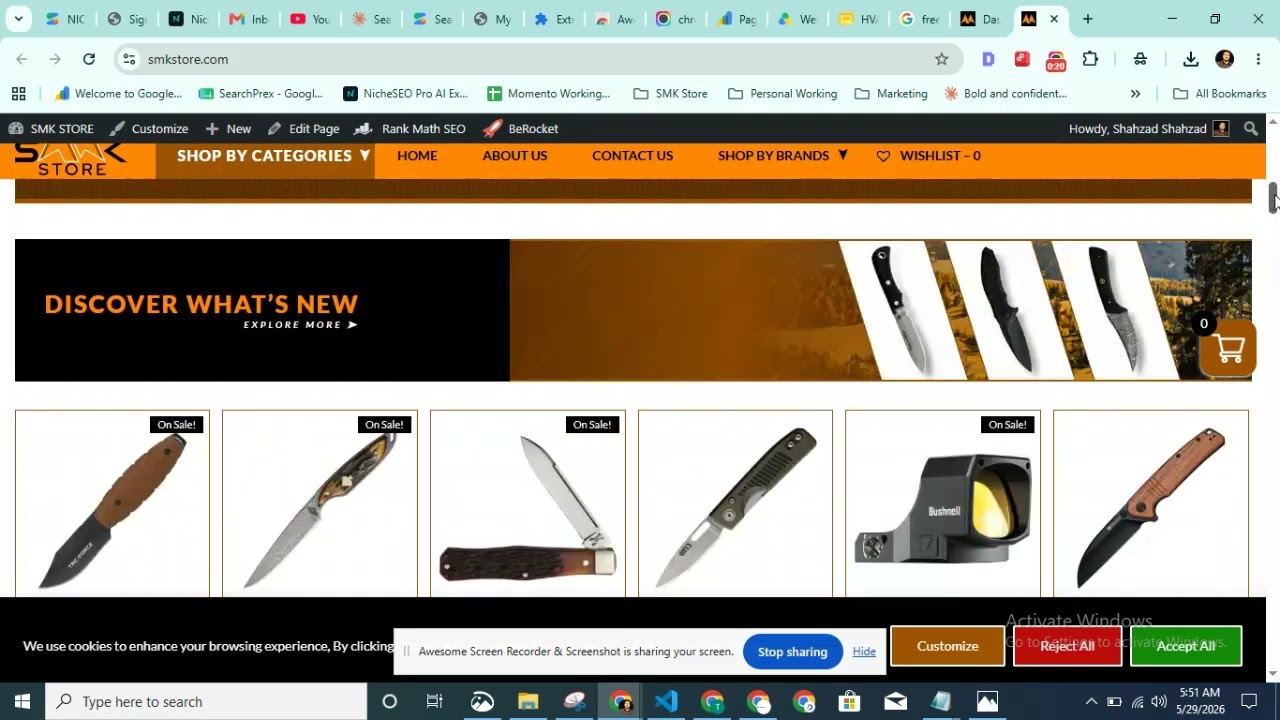
SMK Store · April 2026
SMK Store · June 2026
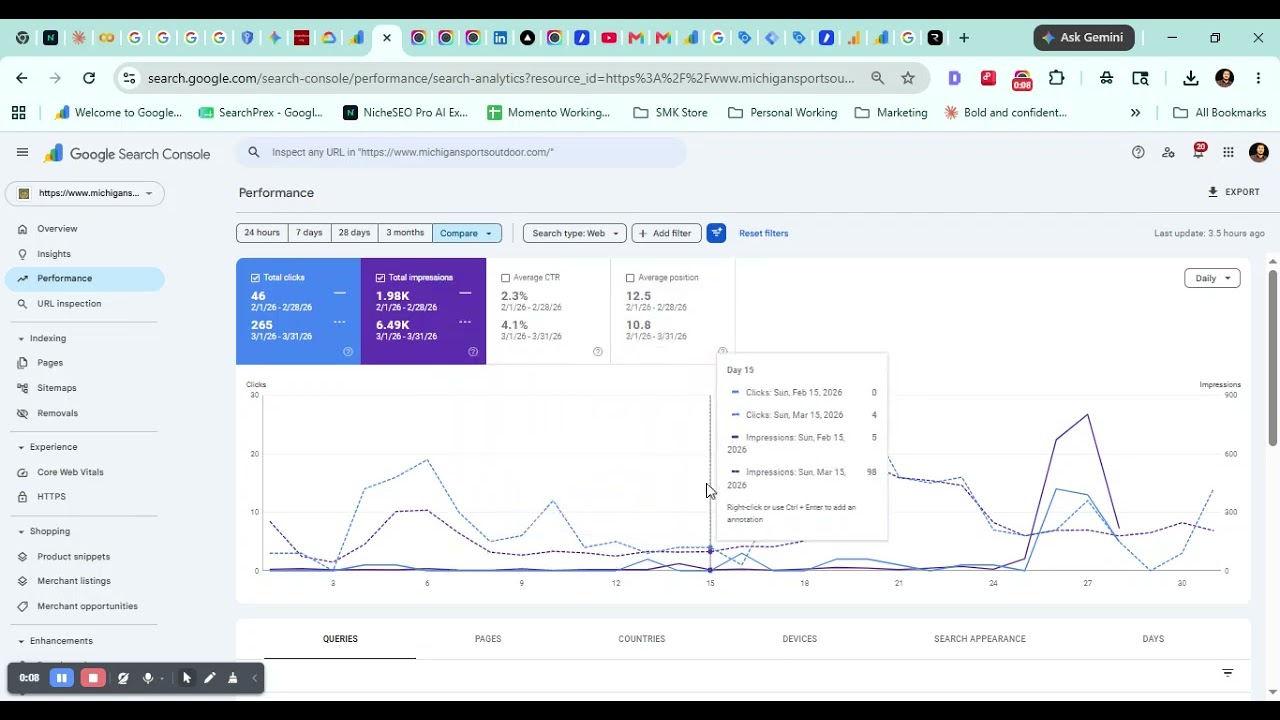
Michigan Sports & Outdoor · May–Jul 2026
Ecommerce · United States
Monthly net sales from $5,832 to $19,100 in two months — after rebuilding thin content, indexing and site quality across a 35,000-product catalog.
- +227%
- Monthly net sales
- $5.8K
- April 2026
- $19.1K
- June 2026
Ecommerce · Michigan, USA
+285% pages indexed and +83% US organic clicks — rebuilt after a de-indexing event.
- +285%
- Pages indexed
- 11,549
- Pages now indexed
- +83%
- US organic clicks
A four-phase engagement, built for scale
Predictable process, transparent reporting, no black-box tactics.
Reality check audit
Full technical + content + indexing audit. Crawl your site, pull GSC + GA4 data, benchmark against 2 competitors, and deliver a 90-day roadmap with priorities scored by impact and effort.
Strategy & scoping
Confirm target categories, product batches, and technical fix priorities. Align on tooling (WordPress, Shopify, custom), reporting cadence, and content production capacity.
Execution
Weekly sprints — technical fixes shipped by our dev partner, content published in measured batches, schema deployed, and resubmitted through Search Console. Every change logged in a shared roadmap.
Monitor & iterate
Weekly reporting on indexation rate, impressions, clicks, and revenue attribution. Monthly review call. Automated alerts for indexing drops, ranking losses, and Core Web Vitals regressions.
The stack we run every program on
- Google Search Console
- GA4
- Screaming Frog
- Ahrefs
- Semrush
- Surfer SEO
- Looker Studio
- Log File Analyzer
- PageSpeed Insights

Mubashar Sharif
Semrush-certifiedFounder & Lead Ecommerce SEO Strategist · 5+ years
Full-stack ecommerce SEO — technical SEO, on-page optimization, content strategy, structured data, and indexing recovery at scale. Both published case studies are WooCommerce stores, one with more than 35,000 products.
- Semrush certified
- +92 305 9158010
Why choose SearchPrex for ecommerce SEO
A small, founder-led agency. Here is what that means in practice.
The founder does the work
Mubashar Sharif runs every audit, writes every plan and sends every report. No sales team, no account managers, no juniors learning on your site.
Results you can check
Every figure on this site has a screenshot from the client's own Search Console, Business Profile or store dashboard behind it. See the case studies.
Fixes, not just a report
The work is the changes themselves — templates, redirects, schema, product and collection copy — not a PDF of problems for someone else to fix.
Published prices, month to month
Ecommerce SEO runs $1,500 – $4,000 a month, depending on scope. No long-term contract. Full pricing.
A free tear-down first
Send your URL and get a written look at what is holding you back within 24 hours, before you pay anything or sign anything.
A 90-day money-back guarantee
Nobody can honestly guarantee a Google position. What I guarantee is progress: if you don't see measurable progress within 90 days, I either keep working at no extra cost until you do, or refund what you paid for those 90 days. You see where things stand in a report every Monday.
Ecommerce SEO for your kind of store
WooCommerce and knife & outdoor stores are where the case studies are. The Shopify page says plainly that there isn't one yet.
The case studies and guides behind this page
SMK Store case study
35,000 products: thin copy, indexing and site quality rebuilt — $5,832 to $19,100 a month.
OpenMichigan Sports & Outdoor case study
A de-indexing setback, then about 3,000 to 11,549 indexed pages.
OpenWooCommerce SEO checklist
25 checks in the order the case-study work was done. Free, no email.
OpenTechnical SEO services
Crawling, indexing and Core Web Vitals fixed at the template — the base every catalogue needs.
OpenCrawl budget optimization guide
Why Google skips pages on big sites, and how to stop it.
OpenProduct page SEO at scale
Writing product pages for 10,000+ SKUs without thin or duplicate copy.
OpenEcommerce SEO news
What changed in search for stores this month, with sources.
OpenEcommerce SEO pricing
$1,500 – $4,000 / month
Shopify & WooCommerce stores: Technical SEO at scale · Product page content · Schema & indexing
Where a store lands in the range depends on catalogue size, technical scope and content volume. Month to month.
Full pricingFrequently asked questions
How long before we see results?
Indexing and Core Web Vitals fixes usually show in Search Console within two to four weeks of Googlebot recrawling. Category and product content takes longer to move rankings, and revenue follows rankings. On Michigan Outdoor Sports the indexing recovery took about ten weeks, May to July 2026.
Do you work on Shopify, WooCommerce, or custom platforms?
All three. The case studies on this page are WooCommerce stores (SMK Store, Michigan Sports & Outdoor); Shopify and custom builds get the same diagnosis with platform-specific fixes, and implementation is handled with a development partner where needed.
What if my products have thin content and I can't write for all of them?
That's most of what we do. We build programmatic content pipelines — unique HTML per product, FAQ schema, meta descriptions, internal links — published in batches and re-measured in Search Console before the next one goes out.
How do you handle indexing at scale?
By fixing the reason Google declined each URL rather than resubmitting harder. Sitemap ↔ GSC diffing runs daily and sorts unindexed URLs by the reason in Search Console's Pages report — crawled-not-indexed is usually thin or duplicate content, discovered-not-indexed is usually crawl budget or missing internal links. High-revenue URLs are fixed first, resubmitted in batches, and URL Inspection is kept for the handful that are genuinely urgent.
Do you touch conversion rate, or just SEO?
Primary focus is organic acquisition, but we handle CRO adjacent to SEO — product page structure, category page templates, breadcrumbs and related products. Full CRO programs are a separate scope.
How much does ecommerce SEO cost?
Ecommerce retainers run $1,500 – $4,000 a month, depending on catalogue size, technical scope and content volume. Every engagement starts with the free tear-down — no commitment, month to month.
Send me your store URL. I’ll tell you what Google is ignoring.
Two fields. Which products are indexed, which aren’t and why — from me, within 24 hours.
Or book a 30-min call