Answer Engine Optimisation is full of confident numbers and thin sourcing. Here is what is actually documented about LLM search in 2026 — and what is still guesswork.
Why this page is shorter on statistics than most
Search "LLM SEO statistics 2026" and you will find dozens of pages quoting precise referral shares, citation rates and traffic percentages. Trace those numbers and most lead to other blog posts rather than to a study, a platform disclosure or a named dataset. We publish the ones that trace to a named source and leave out the ones that do not — which makes this page less dramatic and more usable.
What is documented about LLM search in 2026
Google's answer engine, by Google's own numbers
At I/O 2026 Google confirmed AI Overviews passed 2.5 billion monthly users and AI Mode passed 1 billion, with AI Mode queries more than doubling each quarter since launch. Gemini 3.5 Flash became AI Mode's default model globally, and AI Overviews and AI Mode were merged into one continuous experience, live worldwide on desktop and mobile.
Site owners got their first native AI visibility data
Search Console's Search Generative AI performance reports arrived June 3, 2026, covering AI Overviews, AI Mode and AI features in Discover — impressions, pages, countries and devices, with data starting May 18, 2026 and no backfill. No clicks, no CTR, no queries. Full detail in our AI SEO deep-dive.
Opting out of AI features is separate from ranking
The control Google shipped alongside those reports lets a site stay out of AI Overviews, AI Mode and AI Overviews in Discover. Google states it is not used as a ranking signal for search results outside those generative AI features. Opting out forfeits AI traffic without, on Google's account, affecting organic position.
The distinction that actually governs your AI visibility
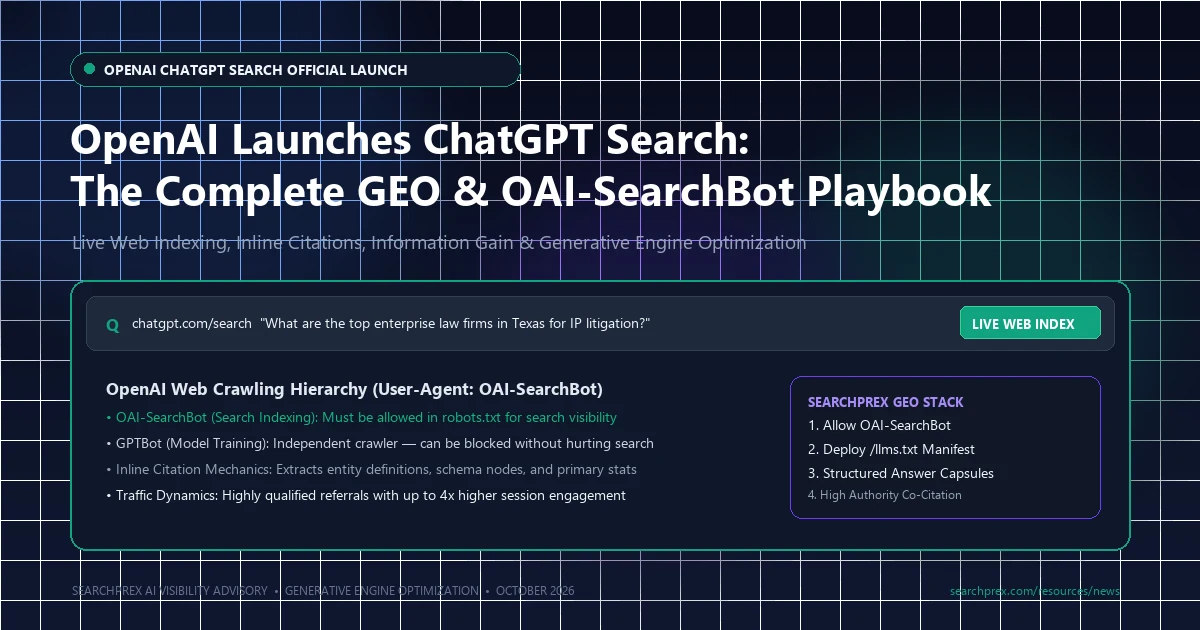
The single most consequential technical decision in AEO is one many sites make by accident in robots.txt: training crawlers and retrieval crawlers are not the same thing.
- Training crawlers (for example
GPTBot,Google-Extended) gather content used in model training. Blocking them does not affect your Google rankings. - Retrieval crawlers (for example
OAI-SearchBot) fetch pages to cite in live answers. Block these and you remove yourself from being cited as a source in that platform's search product.
Sites regularly block both with a single broad rule, intending to protect content from training, and quietly delete themselves from answer-engine citations in the process. If you want to be cited but not trained on, those are two different directives and they must be written separately. Our technical SEO news roundup covers the implementation.
What AEO practice comes down to
Stripped of the jargon, the durable techniques are unglamorous:
- Lead with the answer. A direct two-to-three sentence response immediately under the heading, before context and nuance. Synthesised answers lift self-contained passages; a paragraph that only makes sense after 400 words of preamble cannot be lifted.
- Own a fact. Original data, first-hand testing, documented client results. If five sources say the same thing, a model has no reason to cite any particular one. If one source has the number, citing it is unavoidable.
- Be consistently identifiable. Same organisation name, same author identity, same core claims across your site and off it. Answer engines resolve entities; ambiguity gets you skipped.
- Structure for extraction. Descriptive headings that match real questions, short paragraphs, tables for comparisons, lists for sequences.
- Stay crawlable to the bots you want. All of the above is void if a retrieval crawler cannot fetch the page.
llms.txt package" as a Google requirement is selling something Google says is not required.What still cannot be measured honestly
- AI Mode and AI Overviews clicks arrive in analytics bundled into
google / organic. There is no native split. - Search Console's AI reports give impressions without clicks, so AI-surface CTR cannot be derived from Google's data.
- Third-party trackers sample prompts to estimate share of voice. That is a legitimate directional signal and a reasonable way to benchmark competitors — it is not a measurement of your traffic.
Treat AEO reporting the way you would treat brand tracking: directionally valuable, not a substitute for a traffic number.
← Back to the SEO News hub for the running algorithm tracker and every other deep-dive.
Sources
- Google Search's I/O 2026 updates: AI agents and more — Google Blog
- Introducing Search Generative AI performance reports in Search Console — Google Search Central
- New opportunities, control and insights for website owners — Google Blog
- Google Search's AI features and your website — Google Search Central
Mubashar Shahzad
Dedicated to tracking and decoding the latest Google algorithm updates and SEO trends.