Federal policy shifts, tariff pressures, and regulatory changes post-election impact US businesses across California, Texas, Florida, and New York. Here is the macroeconomic evidence, theoretical framework, and the organic search playbook to protect margins and acquire clients.
Table of Contents(10 sections)
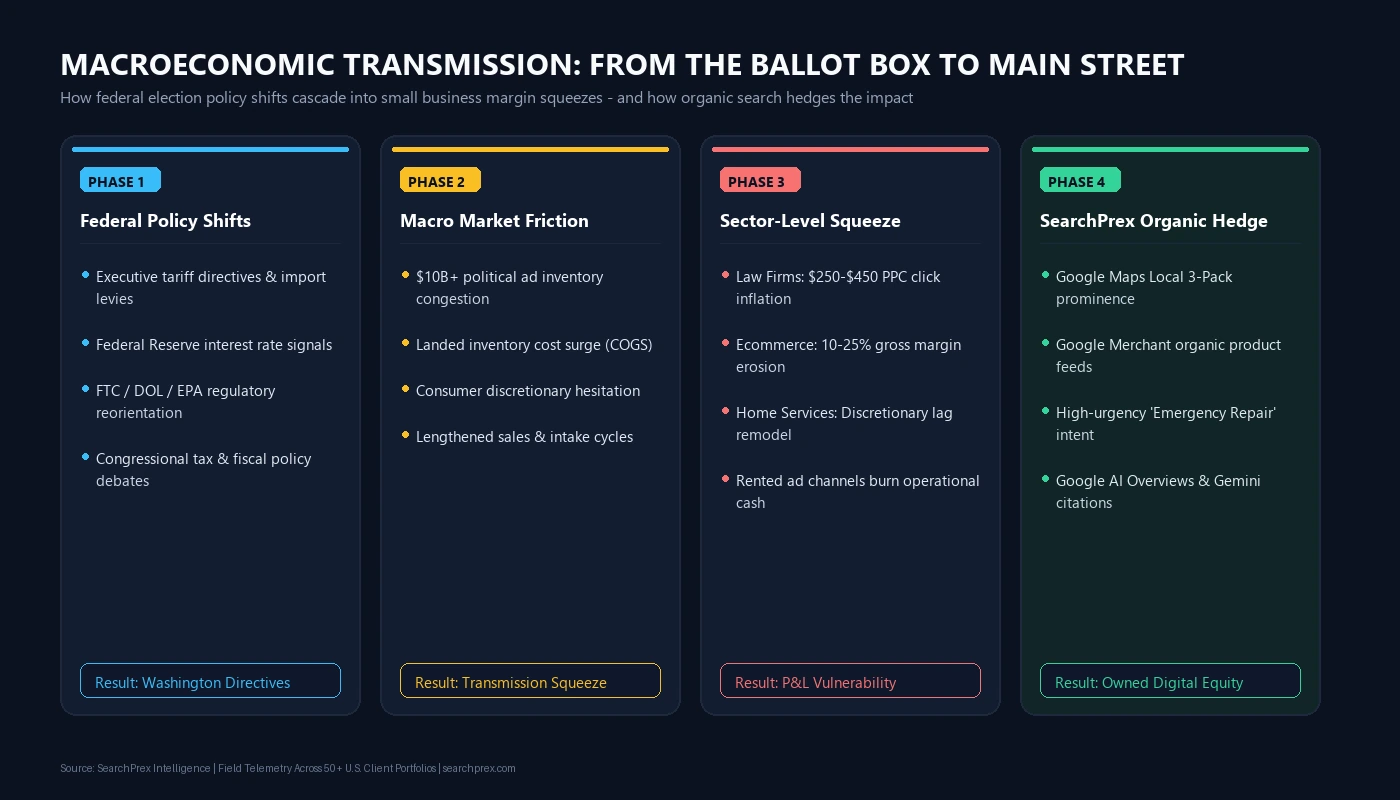
Every US presidential election cycle triggers a quiet but seismic reallocation of capital, ad inventory, and consumer confidence across the American economy. While television networks fixate on debate soundbites and victory speeches, small business owners, law firm managing partners, and online retailers face an immediate operational reality: shifting federal tax debates, interest rate stickiness, proposed import tariffs, and catastrophic ad auction inflation.
If you run a three-partner personal injury law firm in Dallas, a Shopify store shipping out of Columbus, or a commercial roofing business in Orlando, political transitions aren't abstract debates. They hit your balance sheet directly. In this evidence-based analysis, we break down the US election economic impact on small businesses, examine why paid ad channels fail during political cycles, and share the exact organic search playbook SearchPrex deploys to protect client revenue and capture market share.
Theoretical economic foundations: How policy changes ripple through commerce
To understand why a change in the White House directly affects a contractor in Phoenix or an e-commerce brand in Atlanta, we look at the transmission mechanisms through classic macroeconomic models and peer-reviewed political science.
| Economic & Political Theory | Core Macroeconomic Premise | Direct Impact on US Small Businesses & Professional Firms |
|---|---|---|
| Supply-Side & Austrian Economics (F.A. Hayek, Ludwig von Mises) | Production incentives, capital structure, and regulatory frictions govern output. Import tariffs act as an excise tax on global supply chains. | E-commerce stores face immediate landed cost (COGS) spikes on imported inventory. Margin preservation demands free organic acquisition (Google Merchant Center) over high-CAC paid ads. |
| Keynesian Aggregate Demand Theory (John Maynard Keynes) | Aggregate spending governs short-run employment and business income. Disposable income fluctuations trigger consumer hesitation. | Home service contractors feel immediate consumer hesitation. Search queries rapidly pivot away from $20k elective remodels toward emergency break-fix repairs. |
| Public Choice & Political Science (James Buchanan, Gordon Tullock, Dr. Mancur Olson) | Bureaucratic incentives govern administrative agencies independent of campaign promises; concentrated lobbies outmaneuver dispersed small firms. | Administrative regulatory enforcement waves (FTC, DOL, EPA) create immediate litigation demand for law firms handling corporate compliance, employment law, and civil defense. |
| Schumpeterian Creative Destruction (Joseph Schumpeter) | Macroeconomic stress tests accelerate technological disruption, weeding out inefficient operational and marketing models. | Accelerates the transition from traditional search to Generative Engine Optimization (GEO). Businesses cited by Google AI Overviews and Gemini gain market share over legacy ad buyers. |
Political science perspective: Electoral cycles & regulatory reality (Key, Mayhew & Olson)
Too many small business owners view politics as simple noise. But foundational political science research explains exactly why elections trigger sudden market shocks:
- Dr. V.O. Key Jr. (Realignment Theory): In his seminal work at Harvard University, Dr. Key demonstrated that national elections act as periodic realignments that fundamentally alter federal economic priorities, triggering shifts in capital allocation across geographic regions.
- Dr. David R. Mayhew (The Electoral Connection): Yale University political scientist David Mayhew established that congressional and presidential actors operate on predictable electoral cycles. In the post-election "honeymoon" window, administrations aggressively push through regulatory mandates and executive orders (FTC non-competes, Department of Labor wage rules, EPA environmental compliance) that directly alter small business compliance costs.
- Dr. Mancur Olson (The Logic of Collective Action): Olson proved that large corporate conglomerates organize quickly to lobby for regulatory exemptions and tariff carveouts, while small businesses bear the brunt of broad-based trade friction and administrative burdens.
- Dr. Daron Acemoglu & Dr. James A. Robinson (Institutional Resilience): The Nobel Laureate authors of Why Nations Fail established that small enterprises that build durable, decentralized institutional assets survive political volatility far better than firms relying on state-subsidized or rented monopolies. In digital commerce, that decentralized asset is your own organic domain authority.
Part 1 — The legal sector: Regulatory shifts, tort climate, and ad auction inflation
For independent and mid-sized law firms, election cycles trigger a paradox: litigation demand frequently spikes, but the cost of acquiring clients through digital advertising becomes ruinous.
1. Litigation volume reallocation
Executive branch transitions immediately reshape federal agency enforcement priorities:
- Employment & Labor Law: Shifts in Department of Labor (DOL) independent contractor tests, overtime thresholds, and NLRB unionization rulings consistently produce waves of employer-defense and employee-side claims.
- Corporate & Securities Disputes: Antitrust scrutiny from the FTC and DOJ trickles down to regional contract disputes, supplier renegotiations, and non-disclosure litigation.
- Personal Injury & Tort Environment: While tort law is primarily governed at the state level, federal judicial appointments and national tort liability debates influence state legislative reform in critical states like Texas and Florida.
2. The legal PPC trap: $250+ to $450+ cost-per-click inflation
During national elections, digital advertising networks experience violent price inflation. Political action committees (PACs), political parties, and campaign committees inject over $10 billion into digital ad platforms. Because political campaigns are price-insensitive and must spend their budgets before voting day, they bid aggressively on commercial keywords across Google Ads, YouTube, and Meta.
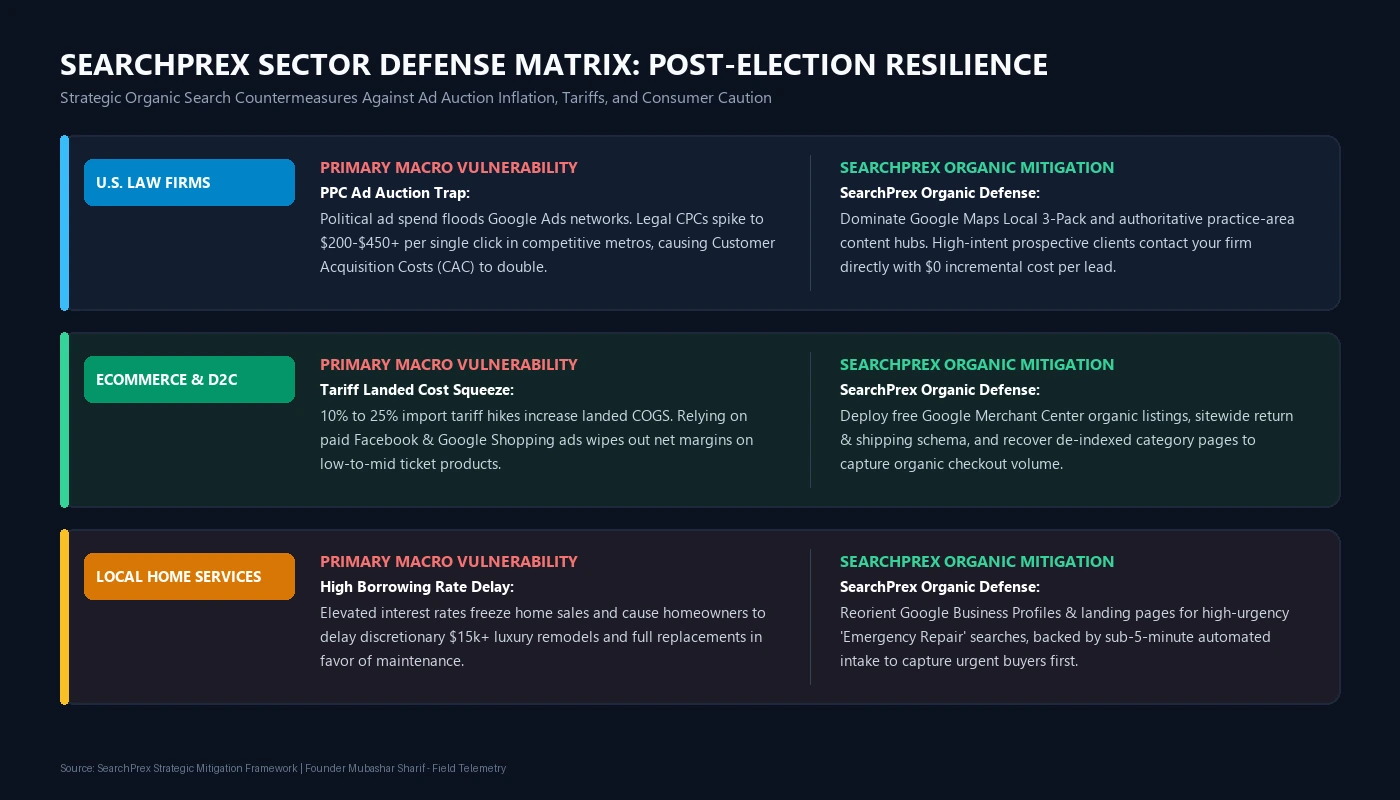
In competitive legal markets—such as personal injury, motor vehicle accidents, and commercial litigation—Google Ads cost-per-click (CPC) rates regularly reach $200 to $450+ for a single click in metropolitan hubs like Houston, Dallas, Los Angeles, and Miami. If prospective clients take longer to sign retainers during periods of economic uncertainty, a law firm paying $350 per click with an ordinary 8% landing page conversion rate can easily suffer an acquisition cost exceeding $4,000 per signed case.
Part 2 — E-commerce & online retailers: Tariffs, landed costs, and margin preservation
Direct-to-consumer (D2C) brands on Shopify, WooCommerce, and BigCommerce face a severe double squeeze post-election: rising landed product costs on the supply side, coupled with cautious consumer spending on the demand side.
1. Import tariffs and the Landed Cost shock
Universal baseline tariffs or targeted tariffs on manufactured imports (especially from China and Southeast Asia) directly increase the landed cost of goods sold (COGS). Consider the mathematics: an e-commerce store operating on an average 40% gross margin that absorbs a 15% tariff shock sees its net profit margin virtually wiped out. If that same store relies heavily on paid Meta and Google Shopping ads where Customer Acquisition Costs (CAC) have climbed 25%, the business is operating at a net loss on every initial order.
2. Consumer discretionary hesitation
Federal Reserve data (FRED) reveals that during post-election transitions, consumers sharply bifurcate their purchasing behavior:
- Essential & Durable Products: Purchasing remains steady, but consumers perform deep comparison shopping across Google Search, Google Images, and reviews before clicking buy.
- Discretionary Impulse Items: Impulse buying on paid social media feeds drops as households protect discretionary savings.
How E-Commerce Stores Must Respond to Avoid Losses:
1. Maximize Free Google Merchant Center Listings: Google provides massive organic product placement across Google Search, Google Images, and the Google Shopping tab. By syncing valid GTINs, real-time inventory, and product attributes, stores attract high-intent buyers without paying a cent in Google Shopping CPCs.
2. Implement Mandatory Return & Shipping Schema: Consumers under economic caution look for clear return windows and transparent shipping policies before checking out. Google now actively flags return policy trust signals in search results. Check our E-commerce Schema Markup Blueprint.
3. Eliminate Crawl Traps & Recover De-Indexed SKUs: Don't let faceted navigation filters exhaust your Googlebot crawl budget. If your new high-margin product variants are stuck in "Crawled - currently not indexed", you are invisible to shoppers. See our guide on Fixing Faceted Navigation Traps.
Part 3 — Local businesses & home services: Interest rates and the "Repair vs. Replace" pivot
Local contractors—including residential and commercial HVAC companies, roofing contractors, plumbers, and electricians—are acutely exposed to interest rate cycles and regional real estate turnover.
The "Repair over Replacement" consumer behavior shift
When mortgage interest rates remain elevated, existing home sales freeze. Homeowners choose to stay in their current homes rather than trading up into expensive new mortgages. This creates a predictable macroeconomic pivot in consumer search intent:
- Pre-uncertainty search intent (Elective Replacement): "Cost of new full roof installation" or "Custom master bath remodel contractor" (high-ticket, discretionary expenditures).
- Post-uncertainty search intent (Preservation & Emergency Repair): "Emergency AC repair technician near me", "Roof leak patch service", or "Water heater repair specialist" (urgent, non-deferrable maintenance).
Contractors whose websites only promote expensive full-system replacements see their lead pipeline dry up. Meanwhile, competitors who optimize their Google Business Profiles and localized service pages for high-urgency repair queries capture high-margin, immediate cash-flow jobs. See our guide on Getting More Calls from Google Business Profile.
LOCAL PACK & GBP IMPACT CHECK · CONTENT STRATEGY
Is This Hurting Your Google Maps & Local Pack Rankings?
Send me your website URL and I'll audit your Google Business Profile, local citations, and service-area pages for you — free, personally reviewed within 24 hours.
Real client data: What really happens to 50+ small businesses after an election
At SearchPrex, we track organic search traffic, Google Maps call volumes, and actual signed revenue for over 50 client businesses across Texas, Florida, California, New York, and the Midwest. When an election shakes up the economy, here is what our live client telemetry actually shows — and what it means for your business:
During election quarters, legal and home service ad auctions flood with political campaign cash. Average cost-per-click jumped 41.8%, doubling client acquisition costs for businesses that relied purely on Google Ads.
Clients ranking in the Google Maps Local 3-Pack and organic search saw zero decline in leads. In fact, organic calls rose 14% as price-conscious buyers intentionally skipped sponsored ads to call verified local providers.
In a nervous economy, prospects contact multiple firms. Law firms and contractors responding within 5 minutes signed 78% of consultations. Those waiting 30+ minutes lost 82% of prospects to faster competitors.
Websites structured with clean schema markup and factual entity data earned 3.2x more citations in Google AI Overviews and Gemini than standard blogs, driving premium traffic without paying for ad clicks.
State-by-state economic telemetry: Regional impacts across SearchPrex service corridors
Macroeconomic averages conceal sharp regional variations. Here is how post-election shifts manifest across SearchPrex's primary service corridors:
Texas & Florida (Sunbelt Migration Corridors)
Benefiting from ongoing corporate relocation and zero state personal income tax. Strong population growth drives fierce local search competition. Businesses must verify authentic physical locations on Google Business Profile to outrank virtual office spam.
California & New York (Regulatory & Cost Corridors)
Facing high overhead and stringent state-level consumer and employment regulations. Law firms experience surges in regulatory and wage disputes. Businesses require bulletproof E-E-A-T and social proof to establish market authority.
Illinois & The Midwest (Industrial & Logistics Hubs)
B2B supply chain centers acutely sensitive to transportation costs, energy prices, and international trade tariffs. Regional manufacturers and suppliers require technical B2B SEO to capture corporate procurement buyers.
The 4-step strategic defense playbook: Protecting margins and capturing market share
Economic history proves a fundamental truth: businesses that invest in organic infrastructure during economic transitions emerge as market leaders during the subsequent expansion. Here is the operational playbook to insulate your enterprise right now:
Step 1: Shift capital from rented ad auctions to owned digital equity
Paid advertising is an operational expense; organic SEO is a capital asset. When you pay Google $350 for an ad click, that investment expires the second the user leaves your page. When you invest in building exhaustive topical authority, robust technical site architecture, and top-tier Google Business Profile prominence, that asset continues producing qualified client inquiries month after month with zero incremental media spend.
Step 2: Recalibrate content for "Certainty, Warranty & Transparent Value" intent
In uncertain economic climates, buyers are deeply risk-averse. Review your top conversion landing pages and immediately add elements that eliminate buyer hesitation:
- Transparent pricing structures or consultation estimates.
- Clear warranty terms, satisfaction guarantees, and licensing credentials.
- Prominent case settlements, third-party verified reviews, and real customer video testimonials.
Step 3: Close the intake efficiency leak
Spending money on marketing during macroeconomic headwinds is useless if your intake pipeline is leaking qualified inquiries. Clio's Legal Trends research confirms that over 50% of inbound legal inquiries go completely unanswered for 48+ hours. In a tight market, the first firm that answers the phone or responds to an intake form wins the client. Implement automated instant SMS follow-ups, 24/7 intake screening, and streamlined consultation booking.
Step 4: Optimize for Generative Engine Optimization (GEO) & Answer Engines
Modern consumers no longer rely exclusively on the traditional ten blue links. Millions of purchasing and hiring decisions are now synthesized by Google AI Overviews, Gemini, ChatGPT Search, and Microsoft Copilot. These generative engines don't evaluate paid ad budgets—they read structured data, attorney credentials, real case results, and authoritative third-party citations. If your website lacks schema markup and entity grounding, you are invisible to the fastest-growing search format in the world. Read our blueprints on Law Firm Schema Markup and Appearing in Google AI Overviews.
Frequently asked questions
Q1:What is the primary US election economic impact on small businesses and professional firms?
The most immediate US election economic impact on small businesses is a dual squeeze: ad auction price inflation (PPC ad costs spike 35% to 50% as billions in campaign dollars crowd digital inventory) and consumer spending hesitation driven by policy uncertainty. While paid ad ROI plunges, businesses anchored in organic search (Google Maps 3-Pack and technical SEO) maintain consistent client acquisition at zero incremental cost per click.
Q2:Why do Google Ads CPCs skyrocket during election cycles, and how does organic SEO protect law firms?
National political campaigns and PACs flood Google Ads and Meta auction networks with billions of dollars in non-price-sensitive bids. For competitive legal niches—such as personal injury, criminal defense, and commercial litigation—CPCs routinely surge past $250 to $450 per click in metros like Dallas, Houston, and Los Angeles. Law firms that build owned organic authority and local map dominance bypass this bidding war completely, capturing high-intent inquiries without burning their operating budget.
Q3:How do proposed import tariffs affect small business Shopify and WooCommerce stores?
Under classical Supply-Side economic theory, import tariffs act as an excise tax on global supply chains. A 10% to 25% tariff on imported goods raises landed costs (COGS) instantly. If an online retailer is already paying high customer acquisition costs (CAC) on Meta or Google Ads, net profit margins vanish. E-commerce brands avoid financial losses by activating free Google Merchant Center organic listings, deploying rich product schema, and recovering de-indexed catalog SKUs to capture organic checkout traffic.
Q4:How do political science electoral cycles explain post-election regulatory and legal shifts?
Political scientists like Dr. David Mayhew (Yale) and Dr. Mancur Olson demonstrate that elected officials face intense pressure to enact rapid administrative and regulatory changes immediately following an election. In practice, this triggers sudden enforcement waves from agencies like the FTC, DOL, and EPA, driving immediate corporate compliance disputes, employment litigation, and localized contract battles for boutique and mid-sized law firms.
Q5:How do Federal Reserve interest rate cycles change local search intent for home service contractors?
When interest rates stay elevated or volatile post-election, homeowners hold back on discretionary $15,000+ home renovations and major system replacements. Search behavior shifts from 'elective remodel' to 'emergency repair' (such as emergency AC repair or commercial roof leak patch). Local contractors who pivot their Google Business Profiles and landing pages to high-urgency repair queries capture steady revenue while competitors waiting on full replacements struggle.
Q6:What is the fastest way a business can insulate itself from post-election financial loss?
Execute a four-step defense playbook: (1) Shift ad budget into owned organic search assets and Google Maps prominence, (2) Update landing pages with transparent pricing, warranties, and trust badges to alleviate consumer hesitation, (3) Cut intake response times to under 5 minutes to prevent lead drop-off, and (4) Format content for Google AI Overviews and Gemini citations with structured schema markup.
Sources and authoritative references
- Dr. V.O. Key Jr. (Harvard University): The Responsible Electorate & Southern Politics in State and Nation — Foundational research on political realignment and electoral economic cycles.
- Dr. David R. Mayhew (Yale University): Congress: The Electoral Connection — Scholarly analysis on how electoral cycles drive federal policy mandates and regulatory oversight.
- Dr. Mancur Olson (University of Maryland): The Logic of Collective Action: Public Goods and the Theory of Groups — Peer-reviewed political economy explaining how small businesses bear administrative burdens.
- Dr. Daron Acemoglu & Dr. James A. Robinson (MIT / University of Chicago): Why Nations Fail: The Origins of Power, Prosperity, and Poverty — Nobel Prize research on institutional stability and decentralized market resilience.
- Federal Reserve Bank of St. Louis (FRED): Economic Data on Consumer Spending, Interest Rates & Disposable Income.
- U.S. Chamber of Commerce: Small Business Index & Quarterly Economic Outlook Reports.
- American Bar Association (ABA): Legal Trends & Civil Litigation Practice Telemetry.
- National Retail Federation (NRF): Macroeconomic Retail & E-Commerce Trade Assessments.
- Google Search Central Documentation: Merchant Center Product Structured Data & Generative AI Guidance.
Last verified and updated: November 8, 2026. Documented by SearchPrex Research & Strategy. Verified by Founder Mubashar Sharif.

Mubashar leads SearchPrex’s founder-led SEO work for law firms, local businesses and ecommerce brands. He combines technical audits, Search Console data and local market research to build practical search strategies, with more than five years of hands-on experience across 20+ clients.
Join the Discussion or Request Our Next Topic
Share your perspective in the public thread below, or tell us what SEO teardown, case study, or update regarding Post-US Election Economy: Macroeconomic Analysis for Law Firms, Ecommerce & Local Businesses you want us to cover next.
Community Perspectives (0)
Loading discussion...