A practical, source-led guide to AI Overview eligibility, attorney-reviewed legal content, jurisdiction-specific sources, Search Console measurement, and what firms cannot control.
Table of Contents(13 sections)
To get a law firm cited in Google AI Overviews, publish useful legal information on pages Google can crawl, index, and show with a search snippet. Make the answer accurate for the relevant state, identify the attorney who wrote or reviewed it, and support legal claims with current primary sources. Google says there are no special AI Overview optimizations, and no firm can guarantee a citation.
This guide focuses on what law firms can responsibly control: technical eligibility, attorney-reviewed content, jurisdiction-specific evidence, internal links, and measurement. It separates confirmed Google requirements from editorial practices that make legal content clearer and more trustworthy to readers.
What is a Google AI Overview citation?
An AI Overview is an AI-generated response that can appear within Google Search and link to pages that support or extend the response. A citation is a link to one of those pages. The linked page may be a legal explainer, a government source, a court resource, or another useful page—not necessarily a law firm's homepage.
AI Overviews are different from the Google Maps pack, Google’s AI Mode, and answers in tools such as ChatGPT or Perplexity. The same accurate website content may help people across several discovery paths, but each surface has its own selection and display systems. A map ranking, review count, or ChatGPT mention does not prove that a firm will appear in an AI Overview.
Legal consumers are exploring AI for legal information: Clio’s 2025 Legal Trends research reported that more than half of surveyed consumers had used or would consider using AI to answer a legal question. That finding is about AI use broadly; it is not a measure of Google AI Overview citations or resulting law firm leads. Read the Clio report and its methodology before applying the result to your own market.
What Google confirms about appearing in AI Overviews
Google’s guidance for AI features is clear: the usual Search fundamentals still apply. A page must be indexed and eligible to appear in Google Search with a snippet before it can be shown as a supporting link in an AI Overview or AI Mode. Google also says there are no additional technical requirements or special optimizations for these features.
Google says AI Overviews and AI Mode may use “query fan-out”: the system can run multiple related searches across subtopics and sources while forming an answer. This is a reason to cover the real context around a legal question where it helps the reader. It is not evidence that every firm needs a separate page for every wording variation, nor that a particular heading or word count guarantees inclusion.
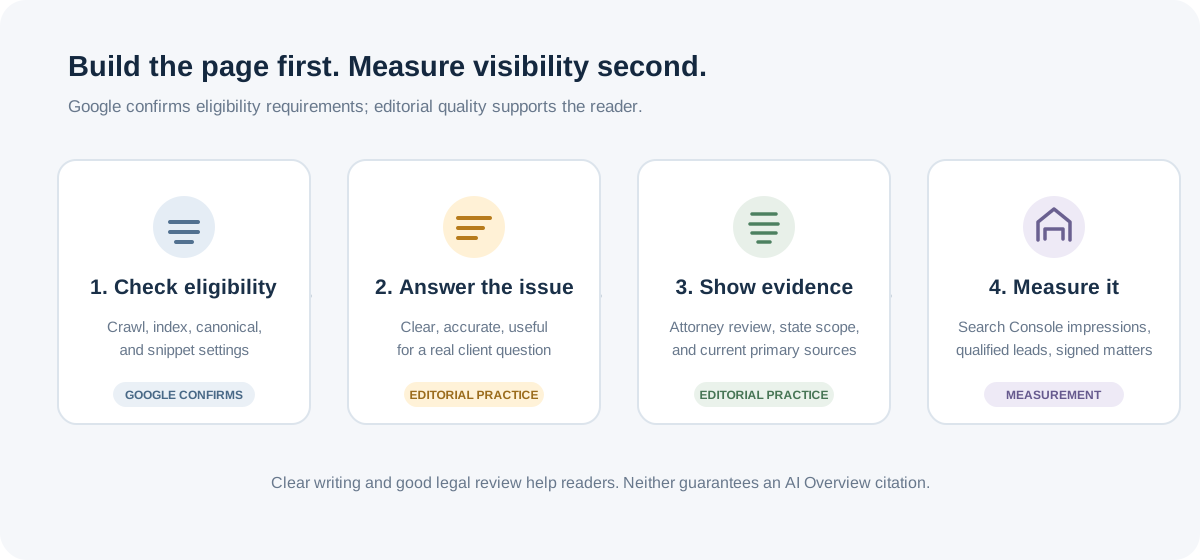
Keep that distinction in mind throughout this guide: eligibility is documented by Google; specific editorial choices are professional recommendations, not secret ranking factors.
First, check whether the page is eligible
Before rewriting an article for AI visibility, check that Google can reach and understand the page. The same conditions that can limit ordinary Search snippets can also limit use as an AI Overview supporting link.
- Allow crawling. Check robots.txt, CDN rules, hosting firewalls, and any bot controls that could block Googlebot.
- Allow indexing. The URL should return a successful response, have a suitable canonical, and avoid an accidental
noindexdirective. - Allow a snippet. Review
nosnippet,max-snippet, anddata-nosnippetsettings. Google documents thatnosnippetprevents content from being used as a direct input for AI Overviews and AI Mode. - Keep the answer in accessible text. Put substantive explanations in page text rather than only in an image, video, or a script-dependent widget.
- Make the page discoverable. Link to important practice-area and legal-information pages from relevant site sections and related articles.
- Check Search Console. Use URL Inspection to review the canonical Google selected and the current indexing status. Eligibility still does not guarantee crawling, indexing, or display.
Google’s snippet controls documentation explains these settings. If an important page is not indexed, solve that problem first; an AI-focused rewrite will not compensate for a URL Google cannot use.
Write legal pages that answer one real client problem
Start with the questions people ask before hiring counsel, then group closely related questions into a useful practice-area page or guide. The goal is a complete answer for a real reader, not a collection of thin pages created to target small wording differences.
Lead with a short answer, then explain the conditions that change it. For law firms, that usually means naming the state or jurisdiction, explaining the relevant process, identifying exceptions, and saying what facts could change the answer. Avoid turning a nuanced issue into an absolute statement just because it fits in a snippet.
Use headings that make the page easy to scan. A question heading followed by a concise answer is a sensible editorial choice, but Google does not say that question headings or a fixed answer length independently earn citations. Continue with the detail a person needs to understand the issue.
| Client question | Useful page | What a responsible answer covers |
|---|---|---|
| How long do I have to file a claim? | State-specific deadline guide | The controlling rule, important exceptions, and a warning that facts can change the deadline |
| What happens after an arrest? | Criminal process explainer | Jurisdiction, typical stages, rights and deadlines, with official court or agency references |
| How much does a lawyer cost? | Fees and engagement page | The firm's actual fee arrangements, possible costs, and what the initial consultation covers |
| What should I do after a car accident? | Practical checklist | Safe, general next steps, documentation, and when to seek case-specific legal advice |
| How does a case move through this county's court? | Local process page | The actual court, local procedure, current official resources, and practical limits |
Use your law firm keyword research tool to discover how clients phrase questions, then decide whether each question belongs on an existing page or warrants a genuinely distinct resource. Our general guide to Google AI Overviews covers the wider SEO context; this article focuses on legal publishing and review.
Show legal expertise without implying a guaranteed outcome
Legal information can influence important decisions. Make it easy for readers to understand who is responsible for the page and what the information does—and does not—cover.
- Name the author and reviewer accurately. If an attorney reviewed the page, identify that person and their relevant admissions or practice area. Do not add an attorney review label unless the review actually happened.
- State the jurisdiction. Rules differ by state and sometimes by court or county. Label the coverage and update the page when a rule changes.
- Cite primary materials. Link to statutes, court rules, court opinions, and official government guidance when they support a legal statement. Include a short explanation in your own words.
- Use first-hand experience carefully. Describe process knowledge or anonymized examples only when they are true, permitted, and not misleading. Follow confidentiality and professional-conduct obligations.
- Show a real review date. Update legal pages when the source law or process changes; do not change dates merely to make an old page appear fresh.
- Set clear limits. Say that the material is general information, not advice for a particular person's facts. Avoid guarantees, unsupported comparisons, or unsubstantiated specialist claims.
State bar rules governing attorney advertising and testimonials vary. Have the responsible lawyer review client-facing legal claims and disclosures for the jurisdictions where the firm practices.
Do schema, FAQs, or llms.txt create a shortcut?
No. Google says no special schema.org markup, AI text file, or new machine-readable file is needed for AI Overviews. Add structured data only when it accurately describes information people can see on the page. It can help systems interpret eligible content, but it does not guarantee a citation or ranking.
The same caution applies to llms.txt. A firm may choose to publish one for other tools to consume, but Google does not require it for AI Overviews or AI Mode. Do not sell, buy, or prioritize it as a proven Google citation lever. Our schema generator is for accurate structured data, not a promise of AI visibility.
Likewise, an FAQ section can help answer real questions, but adding FAQ markup solely to influence AI selection is not a supported shortcut. Avoid padding a legal article with repetitive questions whose answers add no value.
LIVE AI SEARCH & TREND AUDIT · CONTENT STRATEGY
Want Your Brand Cited in AI Overviews for Trends Like "How to Get a Law Firm Cited in Google AI Overviews (2026)"?
Enter your website URL below. I'll personally inspect your entity schema, Answer Capsules, and QDF indexing speed so Google AI Overviews, ChatGPT, and Perplexity cite your pages first — free within 24 hours.
Keep local SEO and AI Overview work distinct
A law firm's Google Business Profile, location information, and genuine reviews matter to local discovery and Maps. They also help prospective clients verify that they have found a real firm. However, Google has not stated that a firm's review count or Business Profile rating is a direct factor for earning an AI Overview citation.
Plan for both surfaces without treating them as interchangeable. Keep profile details accurate, request reviews ethically, and build pages for genuine offices and practice areas. For the Maps-specific steps, see our guide to law firm Google Maps ranking and our Google Business Profile guidance for lawyers.
Measure AI Overview visibility and business impact
As of August 31, 2026, Google says the Generative AI performance report in Search Console is available worldwide. It reports impressions for Google Search generative AI features, including AI Overviews and AI Mode, and lets site owners review pages, countries, devices, and dates. If you do not see a report, Google says the property may not yet have enough impressions.
Use the report to establish a baseline and find which canonical URLs are receiving impressions. Supplement it with a repeatable manual check for priority legal questions: keep the query, state, date, device, and citation URL so changes can be compared responsibly. Results can vary by query and over time, and a manual check is not a ranking guarantee.
Then connect visibility with outcomes. Track qualified calls and forms, the practice area, whether the inquiry became a consultation, and whether a matter was retained. Do not assume every lead was caused by an AI citation, and do not treat impressions alone as signed cases. Our guide to tracking signed cases from SEO covers intake and attribution basics.
A practical 90-day implementation plan
Use the first 90 days to improve eligibility, content quality, and measurement. This is an implementation schedule, not a promise that a citation will appear by a certain date.
Days 1–30: Find and fix eligibility gaps
- Verify Search Console access and inspect priority legal pages for indexing, canonical, snippet, and crawl issues.
- Check the site's Search generative AI control in Search Console and confirm that the firm has not excluded its pages from Google AI features unintentionally.
- Record current organic and generative AI impressions, qualified inquiries, and intake outcomes for a baseline.
- List the practice areas, states, counties, and courts where the firm actually serves clients.
Days 31–60: Improve one priority page at a time
- Choose a useful client question supported by the firm's real practice and jurisdiction.
- Have the relevant attorney write or review the legal substance, sources, qualifications, and limitations.
- Improve the page's title, opening answer, headings, supporting detail, visible authorship, and internal links.
- Use structured data only when it correctly reflects the visible page.
Days 61–90: Measure, maintain, and expand carefully
- Review Search Console's generative AI report and ordinary Search data on a consistent schedule.
- Check whether the selected pages receive impressions and which canonical URLs appear.
- Compare qualified inquiries and signed matters, while being careful not to claim causation from correlation.
- Update pages when underlying law, procedure, attorney credentials, or firm services change; then expand to another genuinely distinct client need.
Mistakes that weaken a law firm's AI visibility work
- Buying citation guarantees. No agency controls Google's answer or can guarantee a citation.
- Repeating outdated percentages as current market facts. A keyword sample is not a universal rate; cite the date, sample, geography, and source—or leave the statistic out.
- Using FAQ schema or llms.txt as the whole strategy. Neither replaces crawlable, useful, accurate pages.
- Publishing attorney bylines without a real review. A false reviewer attribution damages trust and creates professional risk.
- Copying one city page across many markets. Publish local details only when they are accurate and useful to the people the firm serves.
- Equating Maps reviews with AI Overview citations. Measure each surface according to the signals and data available for it.
- Tracking citations without tracking clients. Visibility matters when it helps the right people find and evaluate the firm.
Frequently asked questions
How do I get a law firm cited in Google AI Overviews?
There is no guaranteed citation method. Make the relevant page crawlable, indexed, and eligible for a Google Search snippet; answer the legal question accurately; show who wrote or reviewed it; cite current, jurisdiction-specific primary sources; and link to it from relevant pages on your site.
Does my law firm need special schema or an llms.txt file?
No. Google says there are no special AI Overview requirements, AI-specific files, or special schema needed. Use structured data only when it accurately describes visible page content, and do not treat llms.txt as a Google citation tactic.
Does ranking first guarantee an AI Overview citation?
No. Google does not guarantee citations or publish a rule that the cited page must rank first. The page must be indexed and snippet-eligible, but meeting those requirements does not guarantee that Google will crawl, index, or show it.
How can a law firm measure Google AI Overview visibility?
Use Search Console's Generative AI performance report to review impressions and the pages, countries, devices, and dates associated with Google Search generative AI features. Use repeatable manual checks for individual queries, then compare visibility with qualified inquiries and signed matters.
Do Google reviews make a law firm more likely to appear in AI Overviews?
Google documents reviews as a local ranking and consumer trust signal for Business Profiles, but it has not said that review count or rating is a direct AI Overview citation factor. Keep Maps work and AI Overview measurement separate.
Where to start
Begin with one important legal question the firm can answer accurately, then confirm that the page is eligible for Google Search snippets. Add attorney review, jurisdiction-specific primary sources, clear authorship, and useful internal links. Measure what appears in Search Console and what reaches the firm's intake team.
SearchPrex's free competitor tear-down reviews a firm's search visibility and site structure. Our law firm SEO service can help prioritize the work; no organic ranking or AI citation is guaranteed.
Sources and further reading
- Google Search Central: AI features and your website
- Google Search Central: Robots meta tags and snippet controls
- Google Search Console Help: Generative AI performance report
- Google Search Console Help: Search generative AI control
- Google Search Central: Creating helpful, reliable, people-first content
- Clio: 2025 Legal Trends Report findings and methodology
This article covers search marketing, not legal advice. Legal content should be reviewed for accuracy and for the professional-conduct rules that apply in the relevant jurisdiction.

Mubashar leads SearchPrex’s founder-led SEO work for law firms, local businesses and ecommerce brands. He combines technical audits, Search Console data and local market research to build practical search strategies, with more than five years of hands-on experience across 20+ clients.
Join the Discussion or Request Our Next Topic
Share your perspective in the public thread below, or tell us what SEO teardown, case study, or update regarding How to Get a Law Firm Cited in Google AI Overviews (2026) you want us to cover next.
Community Perspectives (0)
Loading discussion...