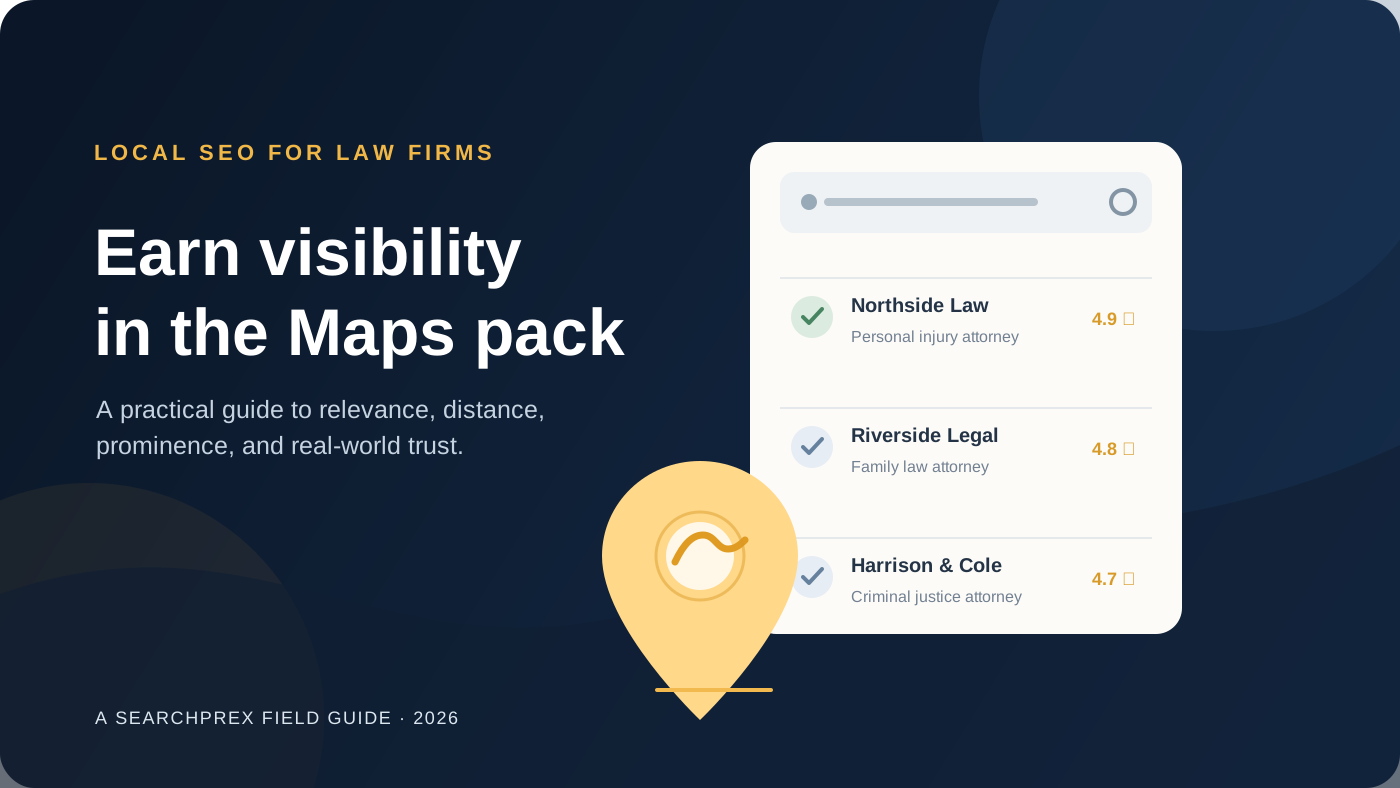
A practical guide to law firm Google Maps ranking: Business Profile eligibility, categories, genuine reviews, local pages, prominence, and measurement.
Table of Contents(15 sections)
Law firm Google Maps ranking comes down to three signals Google names for local results: relevance, distance, and prominence. You can improve how clearly your profile and site match a search, and build the reputation signals that make your firm more prominent. You cannot control how close a searcher is, and no agency can buy an organic Maps position.
This guide explains the practical work behind those signals: confirming your Google Business Profile is eligible, choosing an accurate category, earning reviews ethically, supporting the profile with useful website pages, and tracking visibility across your market. It is written for law firms in the United States; state bar advertising and confidentiality rules vary, so review public-facing claims for your jurisdiction.
What is the Google Maps pack?
The Google Maps pack—also called the local pack—is a map and a small set of local business profiles shown within Google Search for queries such as “divorce lawyer near me” or “personal injury attorney in Cleveland.” A profile can help a prospective client compare nearby firms, see location and contact details, read reviews, and visit a website or place a call.
For a law firm, local visibility is valuable because many people search when they need help in a particular place. The map is one part of the search results, alongside paid placements, organic pages, directories, and increasingly other search experiences. It is useful to compete for Maps visibility, but rankings alone do not show whether inquiries are qualified or become clients. Track calls and signed matters as well as position.
How Google decides which law firms appear in local results
Google says local results are mainly based on relevance, distance, and prominence. Google describes these as broad factors, not a formula, and says there is no way to request or pay for a better local ranking.
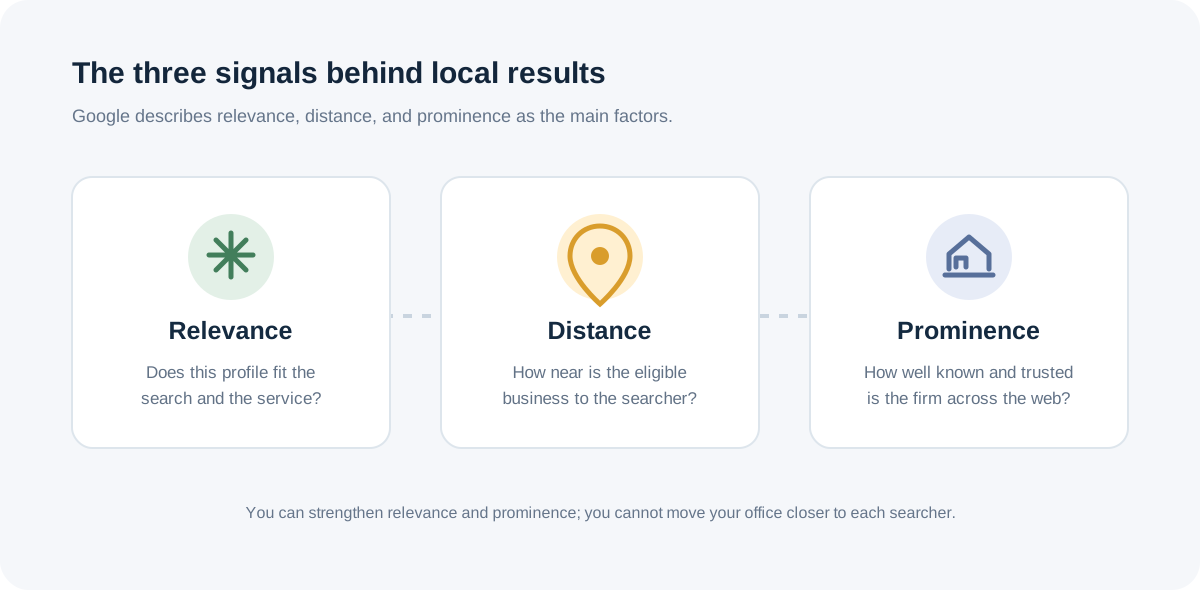
- Relevance: How well your Business Profile matches the service or business someone searched for. Accurate categories, services, and complete business information help Google understand that fit.
- Distance: How far the business is from the searcher or the location named in the query. A strong profile cannot make an office appear physically closer to someone across town.
- Prominence: How well known the business is. Google notes that information such as links to the business and reviews can contribute. Local recognition and consistent, credible business information support this broader reputation picture.
These signals work together. A profile that is highly relevant to one practice may not be the closest option for every searcher, and a nearby firm may still be a poor match if its profile is incomplete or unclear. Treat rank differences across neighborhoods as useful information about local competition, not as a single site-wide score.
Start with an eligible, accurate Business Profile
Before adding keywords or publishing updates, make sure the profile represents a real business location or eligible service-area business. Google requires businesses to represent themselves accurately. Its Business Profile guidelines explain that a virtual office is not eligible when the business does not operate there, and that coworking offices must meet specific signage, staffing, and customer-reception requirements.
For a firm with a client-facing office, use the real address where the business operates and clients can be served. For a practice that travels to clients without receiving them at its address, review Google's service-area rules and hide the address when required. Do not rent a mailbox or use an unstaffed address to simulate a presence in another city.
- Use the firm's real-world name, matching its signage and other business materials. Do not add practice keywords, city names, or promotional phrases unless they are genuinely part of the business name.
- Maintain one profile per eligible location. Multiple listings for the same office can confuse clients and create policy problems.
- Complete verification and keep the address, hours, phone, website, and ownership information current.
- If you are inheriting an old profile, resolve ownership, address changes, duplicates, and any suspension before creating another listing.
If the profile is suspended, first identify and correct the underlying issue, then follow the documented reinstatement process. Our Google Business Profile suspension guide covers the recovery workflow.
Choose the most accurate primary category
Your primary category should describe the firm's main service as specifically as Google's current category list allows. Depending on the practice, that may be a category such as “Personal injury attorney,” “Divorce lawyer,” or another legal category available in the profile editor. Category names and availability can change, so choose from the options Google currently presents.
Use secondary categories only for additional services the firm genuinely provides. Do not select a category because you hope it will attract unrelated searches, and do not treat a category as a keyword list. For a firm with several major practices, create substantive website pages for those practices and make the profile's services accurate. See our practical Google Business Profile guide for lawyers for more field-level guidance.
Complete the profile to help clients decide
Complete information helps Google understand the business and gives a prospective client fewer unanswered questions. Think of profile work as both search relevance and client service.
- Description: State the firm's practice areas, service locations, and approach in straightforward language. Avoid unsupported superlatives, guarantees, or claims that could mislead prospective clients or conflict with bar rules.
- Services: Add the actual legal services offered, using client-friendly descriptions. Keep the list focused on work the firm accepts.
- Hours and contact details: Keep hours accurate, including holiday changes, and use a phone number the firm answers. If call tracking is used, preserve a consistent primary number across important listings.
- Website link: Send visitors to the most relevant page for that office. A single-location practice may use its homepage; a multi-office firm should consider a useful office page. Add campaign tracking if it is configured correctly.
- Photos: Use genuine, current images of the office exterior, reception area, meeting rooms, and attorneys where appropriate. Images should represent the actual firm and location.
- Questions and updates: Answer prospective-client questions accurately and keep profile information current. Posts and updates can help people understand what is happening at the firm, but do not rely on posting frequency as a guaranteed ranking lever.
Build a steady, ethical review process
Google says reviews and positive ratings can help a business's local ranking. Reviews also give prospective clients first-hand perspectives as they compare firms. There is no universal review count that guarantees a Maps position; the local competitive landscape and the firm's overall profile matter.
Ask clients for honest feedback through a direct review link as a normal part of the client experience. Google allows businesses to ask for reviews but prohibits incentives, fake engagement, and selectively soliciting only positive reviews. Its review guidance explains the permitted approach.
- Invite all appropriate clients to share an honest review; do not filter the request based on whether you expect a positive rating.
- Never offer money, discounts, gifts, or services in exchange for a review, an edit, or removal of a negative review.
- Do not ask staff, friends, or people without a genuine client experience to post reviews.
- Respond calmly and briefly. Do not confirm that someone is a client, mention a matter, or reveal any confidential information in a public reply.
- Check your state's professional-conduct rules before using testimonials or discussing outcomes in review replies.
A thoughtful response can show that the firm is attentive, but it does not replace confidentiality obligations. If a review raises a serious concern, move the conversation to an appropriate private channel and follow the firm's ethics process.
Make the website support the profile
The website should confirm the firm details clients see in the profile and answer the questions they need to resolve before contacting a lawyer. Build pages for real services and real locations, not a large set of near-identical city pages.
Create a useful page for each office
Each real office page should make it easy to confirm the address, phone, hours, attorneys, parking or transit information, and the legal services handled at that location. Include local context only when it is accurate and useful—for example, courts or jurisdictions the attorneys actually serve. Never imply a physical office where none exists.
Give major practice areas their own pages
A dedicated practice page should explain the types of matters handled, the questions clients commonly ask, the process for contacting the firm, and the attorney's relevant qualifications. Avoid duplicating broad generic copy across practice areas. Our law firm keyword research tool can help map client language to useful pages.
Show who is responsible for the legal information
Law-related content can affect important decisions. Identify the attorney or qualified reviewer where appropriate, show relevant credentials accurately, include a real publication or review date, and distinguish general information from legal advice. Avoid making unsupported claims about results or expertise.
Use structured data accurately
LocalBusiness or LegalService structured data can help search systems interpret information already visible on the page, such as the firm's name, address, phone, and website. Mark up only information that is accurate and present to users. Structured data does not guarantee a ranking or enhanced search result. Our schema markup generator can help prepare a starting point for review.
Also check that office pages work well on mobile, load promptly, use clear click-to-call links, and provide accessible contact options. A search visibility win is wasted if a prospective client cannot find the number or reach the office.
LOCAL PACK & GBP IMPACT CHECK · LOCAL SEO
Is This Hurting Your Google Maps & Local Pack Rankings?
Send me your website URL and I'll audit your Google Business Profile, local citations, and service-area pages for you — free, personally reviewed within 24 hours.
Keep citations consistent and earn local recognition
Business name, address, and phone information should be accurate anywhere the firm is listed. Start with authoritative legal and local directories, bar association listings, and major map platforms. Correct old addresses and phone numbers, and investigate duplicate records rather than submitting the same information everywhere without review.
Prominence is built through genuine recognition: local press coverage, useful expert contributions, community involvement, professional associations, and reputable links or mentions. Prioritize work that is real and relevant to the firm. Avoid bulk directory schemes, paid link networks, and promises of hundreds of links; quantity alone is not a substitute for trust.
Measure local visibility across the service area
A ranking check from the law office measures one search location at one moment. Because distance affects local results, a firm may appear prominently near the office and less often farther away. A geo-grid or map-grid report helps visualize those patterns across multiple points. It is a diagnostic view, not a promise that every searcher will see the same rankings.
Use a baseline and compare like with like over time. Pair visibility data with:
- Business Profile performance: calls, website clicks, direction requests, and other available interactions.
- Website analytics: visits from the profile link and meaningful contact actions.
- Intake and CRM data: answered calls, qualified consultations, retained matters, and the source recorded by the intake team.
- Search Console: impressions and clicks for relevant non-branded searches and landing pages.
Keep a note of profile edits, address changes, category changes, review activity, and major site updates so you can interpret movement. For a deeper review of a sudden decline, read our guide to Google Maps ranking drops. For measuring outcomes beyond rank, see how to track signed cases from SEO.
A practical 90-day work plan
This plan organizes implementation into manageable phases. Ninety days is a working horizon for completing and reviewing the work, not a promise that a firm will reach the Maps pack in that time. Competition, proximity, profile eligibility, and the firm's starting point all affect what happens.
Days 1–30: Fix the foundation
- Confirm eligibility, profile ownership, verification status, address, and duplicate listings.
- Choose accurate categories and complete core profile details.
- Set up baseline geo-grid visibility, profile reporting, website analytics, and intake source tracking.
- Audit major directories for outdated or inconsistent business information.
Days 31–60: Improve relevance and client confidence
- Improve the real office page and the firm's priority practice-area pages.
- Make sure the website and profile agree on business details and services.
- Introduce a consistent, policy-compliant review request process and respond carefully to existing reviews.
- Check mobile experience, call routing, page speed, and structured data.
Days 61–90: Build prominence and learn from the data
- Correct remaining citations and pursue relevant local recognition or expert coverage.
- Review visibility at points near and farther from each eligible office.
- Compare calls, qualified inquiries, and retained matters with the baseline.
- Prioritize the next improvement based on actual gaps rather than changing multiple profile fields at once.
Common mistakes that hold law firms back
- Adding keywords to the firm name: Use the real-world business name, not a string of cities and services.
- Using an ineligible address: A mailbox or virtual location can lead to profile problems and erode client trust.
- Choosing categories for reach rather than accuracy: Categories should describe actual services.
- Buying or filtering reviews: Incentives and selectively requesting positive reviews violate Google's review policies.
- Publishing cloned location pages: Create pages for genuine offices and useful service information, not doorway pages.
- Checking rankings from one device: Local results vary with search location; use a repeatable measurement approach.
- Focusing on rankings while missing calls: Track whether inquiries are answered and become qualified matters.
- Promising a guaranteed position: A firm or agency cannot guarantee an organic Maps ranking; Google controls the result.
How Maps visibility relates to AI search
There is overlap in the groundwork: accurate firm identity, clear service information, credible attorney credentials, useful pages, and trustworthy third-party references make a firm's information easier to understand across search experiences. But Maps ranking and AI-generated answers are different products with different displays and selection systems. No single schema type or content tactic guarantees that a firm will be named in an AI answer. Keep the priority on information that is accurate, useful to prospective clients, and easy for search systems to interpret. See our overview of AI search visibility for the broader topic.
Frequently asked questions
How long does law firm Google Maps ranking take?
There is no reliable timeline that applies to every firm. The starting profile, proximity to searchers, category competition, local reputation, and website quality all matter. Establish a baseline and look for meaningful movement over time; do not treat a promised number of weeks as a guarantee.
Does a law firm need a physical office to appear in Google Maps?
A firm must meet Google's Business Profile eligibility rules. Client-facing offices should be accurately represented. A service-area business may be eligible without showing an address, but it must follow Google's rules; a virtual office used only for mail is not a substitute for a real business location.
Can my firm rank in a city where we do not have an office?
Distance is one of Google's named local factors, so map visibility can be difficult farther from an eligible location. A useful, accurate website page may still compete in organic search for a market, but it should not imply that the firm has an office there if it does not.
Do more Google reviews improve Maps ranking?
Google says reviews and positive ratings can help local ranking. There is no fixed review threshold that guarantees a position. Ask for genuine, unbiased reviews without incentives or selective review gating, and protect client confidentiality in replies.
Should each attorney have a separate Business Profile?
Only when the individual practitioner meets Google's guidelines for a separate profile and the listing reflects how the person operates in the real world. Review the practitioner rules before creating profiles, and avoid duplicates for the same office or service.
How is the Maps pack different from Local Services Ads?
The Maps pack consists of local organic results, while Local Services Ads are paid placements available to eligible categories and markets. Eligibility, verification, and billing differ. A paid placement does not purchase an organic Maps ranking.
What should we do if our firm's Maps ranking drops?
First check whether the change appears across multiple points on a geo-grid, then review profile edits, eligibility or verification notices, category changes, review activity, and competitor updates. Compare profile interactions and qualified inquiries as well as ranking data.
Next step: assess your local visibility
Law firm Google Maps ranking is an ongoing local search program: an eligible profile, accurate information, genuine client feedback, useful office and practice pages, and a way to tell visibility from business results. The strongest plan starts with the firm's real eligibility and local competition rather than a universal ranking promise.
SearchPrex offers a free competitor tear-down of a firm's website and local search presence. Our law firm SEO service is founder-led, month to month, and limited to one firm per city and practice area. Any engagement terms and guarantee details are set out in writing; no organic ranking is guaranteed.
Sources and further reading
- Google: Tips to improve your local ranking
- Google: Guidelines for representing your business
- Google: Tips to get more reviews
- Google Maps: Prohibited and restricted content
- Google Search Central: Local business structured data
- Google Search Central: Introduction to structured data
General marketing information only, not legal or ethics advice. Law firms should review advertising, solicitation, testimonial, and confidentiality requirements applicable to their jurisdiction.

Mubashar leads SearchPrex’s founder-led SEO work for law firms, local businesses and ecommerce brands. He combines technical audits, Search Console data and local market research to build practical search strategies, with more than five years of hands-on experience across 20+ clients.
Join the Discussion or Request Our Next Topic
Share your perspective in the public thread below, or tell us what SEO teardown, case study, or update regarding Law Firm Google Maps Ranking: How to Rank in the Maps Pack (2026) you want us to cover next.
Community Perspectives (0)
Loading discussion...