Google rewards websites that demonstrate exhaustive, structured expertise over isolated keyword targeting. Here is the step-by-step engineering blueprint to map, build, and interlink content clusters that dominate search in 2026.
Table of Contents(11 sections)
The short answer & executive summary
For more than a decade, SEO practitioners operated on a simple hypothesis: find a high-volume keyword with low competition, write a 2,000-word article, build a handful of backlinks, and collect organic search traffic. In 2026, that playbook is completely obsolete. Google's continuous spam refreshes and generative search models (Gemini) evaluate websites through entity graphs and topical completeness. A standalone article competing against an established topical cluster has virtually zero probability of maintaining page-one visibility.
At SearchPrex, we have engineered semantic content clusters across competitive e-commerce catalogues, regional law practices, and national service companies. In this masterclass guide, we break down the exact mathematical and structural framework required to establish unassailable topical authority in modern search engines.
Why single-keyword SEO died in Google's 2026 spam updates
Between August and October 2026, Google deployed multiple global spam and core system updates that fundamentally reshaped organic search. The primary casualty was opportunistic, isolated content creation—publishing one-off articles on disjointed topics simply because a third-party keyword tool showed search volume.
When Google's quality classifiers evaluate a domain, they analyze the site's topical perimeter. If a financial software website publishes a guide on "best office coffee machines", Google's topical embeddings algorithm recognizes that the URL sits outside the domain's verified knowledge boundaries. Even if the article is well-written, it lacks entity-level context, receives a low topical confidence score, and is suppressed in search results.
| Strategic Dimension | Legacy Isolated Keyword Model | Modern 2026 Topical Cluster Model |
|---|---|---|
| Targeting Approach | One URL per keyword phrase (e.g., targeting exact match queries). | One central pillar entity mapped to exhaustive semantic sub-intents. |
| Internal Linking Structure | Random, contextual links scattered across unrelated posts. | Strict bidirectional siloing (spokes link up to pillar, pillar links down to spokes). |
| Algorithmic Trust Signal | PageRank and anchor text volume alone. | Topical embedding consistency, entity relationships, and Information Gain scores. |
| Update Resilience | Extremely vulnerable to core spam updates and thin-content flags. | Highly resilient; cluster breadth confirms genuine domain expertise. |
| AI Overview Citation Rate | Near zero (ignored as unverified consensus noise). | High (selected as verified primary source cards in Google Gemini). |
How Google evaluates topical authority: vectors, embeddings & knowledge graphs
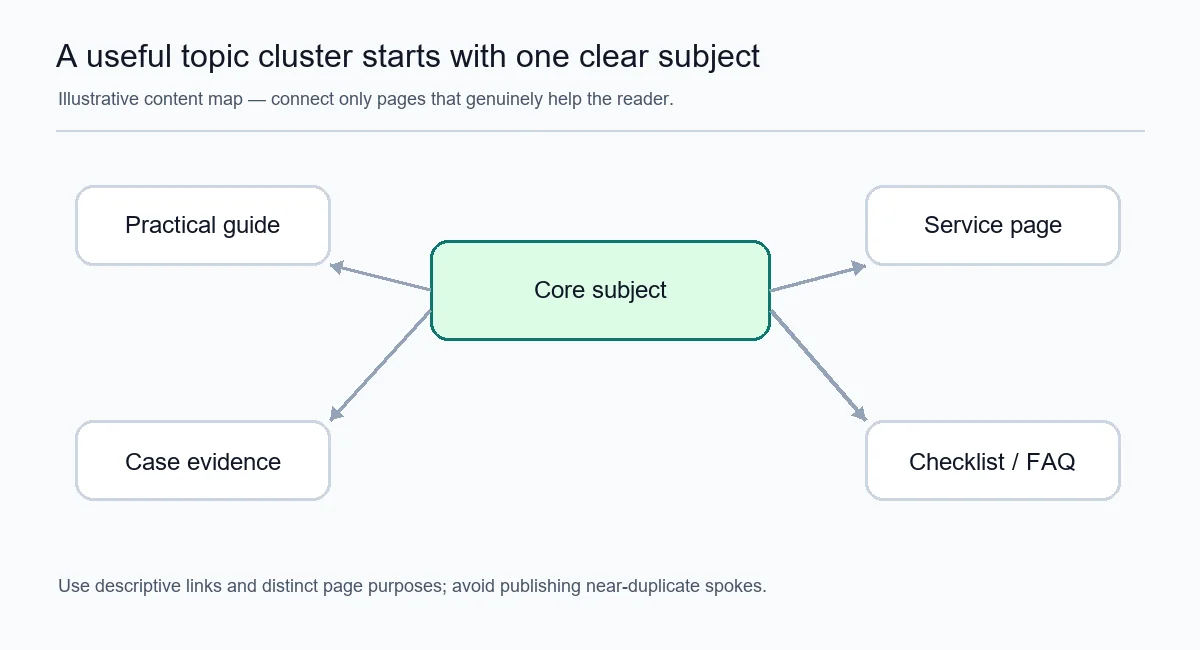
To build an effective topical cluster, you must understand how modern search engines evaluate relevance at a mathematical level. Google does not see your website as a collection of HTML strings; it processes your content as high-dimensional mathematical vectors.
- Entity Resolution: Google maps concepts to verified nodes in its Knowledge Graph (e.g., identifying "Shopify Liquid Canonicalization" not as raw keywords, but as specific software engineering entities connected to e-commerce and indexing).
- Topic Embedding Proximity: Using transformer-based language models, Google calculates the semantic distance between the topics covered across your website. A site where 95% of content clusters tightly around a single parent topic generates a dense, authoritative vector cluster.
- Topical Completeness (Coverage Score): If the Knowledge Graph indicates that an authoritative source on "E-commerce SEO" must encompass site architecture, faceted navigation, product schema markup, Core Web Vitals, and crawl budget, Google checks whether your domain addresses each of those required sub-entities. Missing key sub-topics lowers your overall domain authority score.
The 3-tier hub-and-spoke architecture explained
Topical authority is physical architecture. At SearchPrex, we deploy a standardized 3-tier content hierarchy that channels PageRank and topical context cleanly without dilution:
| Cluster Level | Function & Scope | Target Search Intent | Recommended Word Count |
|---|---|---|---|
| Tier 1: Core Pillar Hub | The comprehensive parent guide covering the high-level topic broadly. Defines the core entity and introduces all sub-facets. | Broad Informational / High Search Volume (e.g., "E-commerce SEO"). | 3,000 – 4,500 words |
| Tier 2: Sub-Cluster Hubs | Specialized branch guides addressing major pillars of the parent topic in deep technical detail. | Commercial / Technical Investigation (e.g., "Product Page SEO", "Faceted Navigation"). | 1,800 – 2,500 words |
| Tier 3: Micro-Spokes | Hyper-targeted articles solving specific pain points, errors, or platform workflows. | Transactional / Immediate Troubleshooting (e.g., "Shopify Canonical Tag Liquid Fix"). | 1,000 – 1,500 words |
Stage 1: Semantic entity extraction & topical mapping
The biggest mistake in cluster building is relying solely on Google Keyword Planner or search volume metrics. Keyword tools show historical query volume; they do not show the underlying semantic knowledge graph of a topic.
How to extract true topical entities
- Inspect Google Knowledge Graph API: Query the Google Knowledge Graph Search API using your primary entity to identify connected objects, types, and official Wikidata associations.
- Analyze Google SERP PAA (People Also Ask) Trees: Scrape 3–4 levels deep of People Also Ask accordions to extract the natural question hierarchy searchers traverse.
- Review Competitor Entity Footprints: Use natural language processing (NLP) extractors to audit the top 3 ranking URLs across your niche. Identify the co-occurring entities, technical terminology, and statutory/procedural references that appear consistently across all top performers.
CUSTOM SEO DIAGNOSTIC · CONTENT STRATEGY
How Does "How to Build Topical Authority with Content Clusters (Step-by-Step)" Apply to Your Website?
Send me your URL and I'll check your site personally against what you just read — technical bottlenecks, competitor gaps, and whether Google's AI names you or them. Free reply within 24 hours.
Stage 2: Calculating Information Gain & avoiding commodity copy
Google holds multiple granted patents regarding Information Gain Scores. When Google evaluates multiple pages answering queries within a topic cluster, its algorithms score each page based on how much novel, non-redundant information it introduces relative to what the user has already read.
If your cluster spokes simply paraphrase the top 3 results from Google, your Information Gain score is zero. Google's spam classifiers will treat your content as redundant commodity copy and withhold indexation. To generate high Information Gain across your cluster:
- Embed Proprietary Test Data: Include specific numbers, benchmarks, and test parameters (e.g., "tested across 35,000 SKUs over a 14-week crawl analysis").
- Publish First-Party Screenshots & Code: Unedited Search Console screenshots, custom script snippets, and architectural flowcharts cannot be generated by commodity AI crawlers.
- Feature Named Practitioners: Attribute content to real specialists with verifiable industry footprints (such as verified author schema linking to professional credentials).
Stage 3: The strict internal linking blueprint (Silos vs. Sprawl)
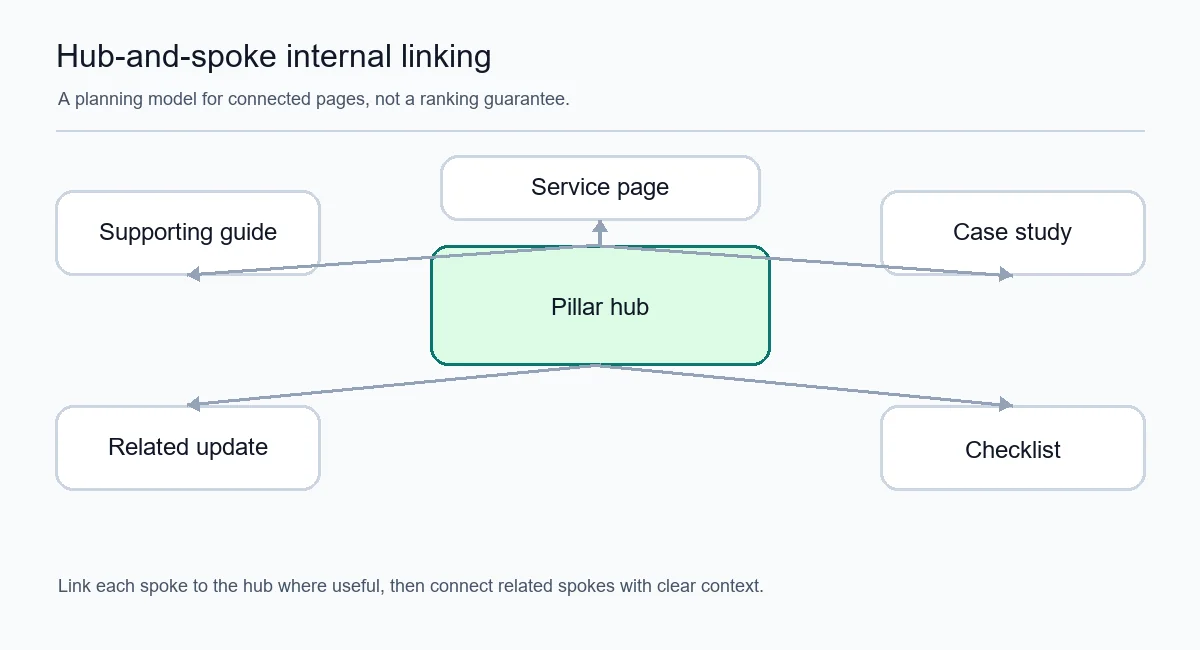
Internal linking is the nervous system of topical authority. Without structured linking, your articles remain isolated islands that Googlebot cannot contextualize.
The 4 Non-Negotiable Internal Linking Rules
- Every Spoke Must Link Up to the Pillar: Within the first 200 words of every Tier 2 and Tier 3 article, place a contextual link back to the Tier 1 Pillar using exact or partial-match descriptive anchor text.
- The Pillar Must Link Down to Every Spoke: The Tier 1 Pillar must contain an organized index or contextual section linking directly to every supporting spoke in the cluster.
- Sibling Spokes Link Horizontally Only When Chronological: Supporting spokes within the same sub-cluster may link to one another only when there is a logical next-step user progression (e.g., from diagnosing an error to applying the fix).
- Never Cross-Link Unrelated Silos at the Bottom: A micro-spoke about WooCommerce caching should not link directly to a guide on criminal defense law. Cross-silo links dilute topical focus and confuse search crawlers.
Stage 4: Diagnosing and eliminating keyword cannibalization
As your content cluster expands past 20 or 30 articles, keyword cannibalization becomes the single greatest risk to your organic traffic. Cannibalization occurs when two or more URLs on your domain target the same core search intent, causing Google to oscillate between them and suppressing both.
How to audit cannibalization in Google Search Console
- Open the Performance Report in Google Search Console.
- Filter by a target keyword query (e.g., "e-commerce indexing errors").
- Click on the Pages tab beneath the performance chart.
- If you see 2 or more URLs splitting impressions and alternating in average position, you have confirmed cannibalization.
- The Resolution: Either consolidate the thinner page into the stronger URL using a 301 redirect, or clearly differentiate search intent by re-optimizing the secondary page for a distinct sub-intent.
Stage 5: SearchPrex real-world case study telemetry
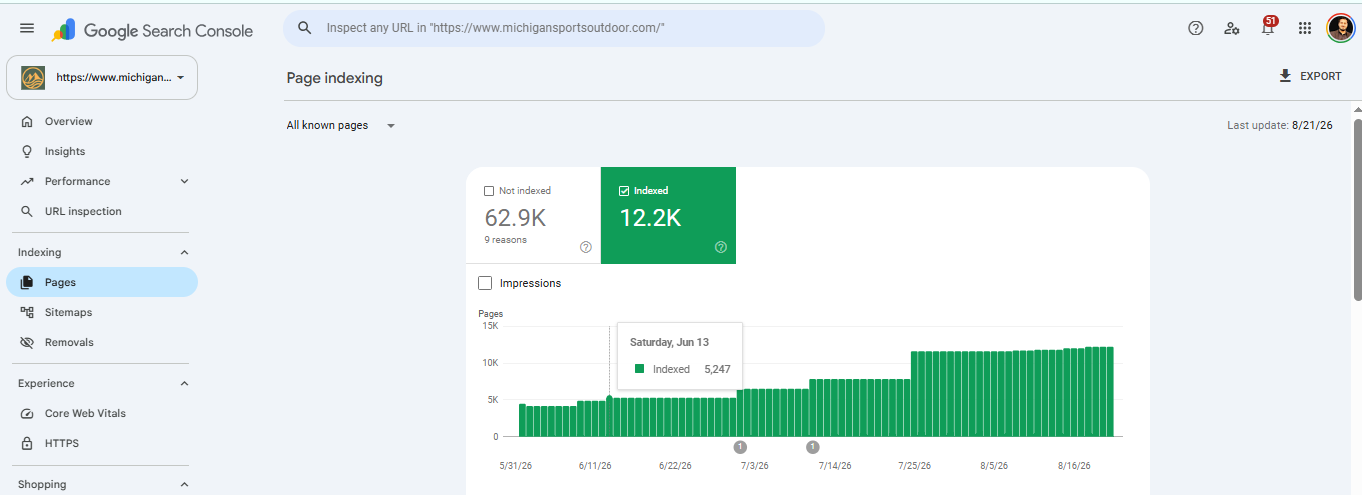
At SearchPrex, we do not teach theoretical SEO; our strategies are proven across enterprise e-commerce platforms and high-ticket service verticals. When we took over technical content architecture for Michigan Outdoor Sports, the brand suffered from thousands of unindexed product and category pages that Google classified as duplicate and thin.
By mapping out structured topical clusters brand by brand and weapon category by category—connecting each product spoke to authoritative buying guides and maintenance pillars—we restored domain trust and unlocked exponential crawl velocity:
Frequently asked questions
How many articles are required to establish topical authority?
There is no fixed universal number. Topical authority depends on the breadth of the target entity. A narrow niche (such as "kitchen knife sharpening") may require only 1 pillar and 6–8 targeted spokes. A broad vertical (such as "E-commerce SEO" or "Personal Injury Law") typically requires 1 main pillar, 4–5 sub-pillars, and 25–40 supporting micro-spokes to achieve dominant market share.
Does building topical clusters help with Google AI Overviews?
Yes, significantly. Google's Gemini models rely on Retrieval-Augmented Generation (RAG). Before an algorithm cites a website in an AI Overview summary, it checks whether the domain possesses verified entity authority in the Knowledge Graph. Sites with complete topical clusters are prioritized as trusted consensus sources over isolated articles. Learn more in our guide on appearing in Google AI Overviews.
How long does it take for a content cluster to rank?
When an entire content cluster (pillar + 5–8 spokes) is published and interlinked systematically, Googlebot typically crawls and indexes the entire cluster within 7 to 14 days. Measurable ranking gains and impressions growth across primary head terms usually materialize within 45 to 90 days as Google validates user engagement and topical completeness.
Can I use AI to write content clusters?
You can use AI for preliminary research, semantic outline generation, and rough drafting. However, publishing unedited AI copy across an entire cluster will trigger Google's late-2026 spam classifiers. Every spoke must contain original human analysis, verified technical data, and accurate internal links to pass Google's element-level quality guidelines.
10-point topical authority audit checklist
- Identify Your Core Parent Entity: Define the primary subject boundary for your domain and verify its existence in the Google Knowledge Graph.
- Map the 3-Tier Hierarchy: Create an architectural blueprint outlining your Tier 1 Pillar, Tier 2 Sub-Pillars, and Tier 3 Micro-Spokes before writing a single word.
- Enforce High Information Gain: Ensure every spoke includes original data, unedited screenshots, proprietary benchmarks, or named expert commentary.
- Implement Strict Bidirectional Linking: Verify that every spoke links up to its parent pillar and the pillar links down to all spokes.
- Audit for Keyword Cannibalization: Regularly check Search Console query reports to ensure multiple URLs are not competing for identical search intents.
- Use Descriptive, Entity-Rich Anchor Text: Avoid generic anchors like "click here"; use exact and partial descriptive phrases matching target entities.
- Add Schema Entity Connections: Utilize
aboutandmentionsproperties in JSON-LD markup to link your pages to official Wikidata concepts. - Optimize Supporting Technical Infrastructure: Ensure your cluster pages pass Core Web Vitals (Core Web Vitals Guide) and feature valid structured data (Schema Markup Guide).
- Monitor Query Impressions in Search Console: Track the total number of distinct queries your cluster earns impressions for; expanding query count is the first sign of growing authority.
- Partner with Architectural SEO Experts: If your website requires comprehensive semantic mapping and enterprise cluster deployment, explore our dedicated Ecommerce SEO or Technical SEO Services, or request a complete architectural review via our Free SEO Audit.

Mubashar leads SearchPrex’s founder-led SEO work for law firms, local businesses and ecommerce brands. He combines technical audits, Search Console data and local market research to build practical search strategies, with more than five years of hands-on experience across 20+ clients.
Join the Discussion or Request Our Next Topic
Share your perspective in the public thread below, or tell us what SEO teardown, case study, or update regarding How to Build Topical Authority with Content Clusters (Step-by-Step) you want us to cover next.
Community Perspectives (0)
Loading discussion...