Most 2026 trend pieces are predictions. This one is a review: what Google actually shipped between January and August, and what it should change about your plan.
A review, not a forecast
The genre problem with "state of SEO" articles is that they are written as predictions and never revisited. This one is built the other way round: from the record of what Google confirmed and shipped between January 1 and August 27, 2026. Every claim is dated and sourced, and where the evidence does not support a popular narrative, we say so.
1. Update cadence went up, and rollouts got shorter
Six confirmed updates in eight months: a Discover core update in February, spam updates in March, June and August, and core updates in March and May. Both core updates took 12 days. The March spam update took about 19 and a half hours — the shortest confirmed spam rollout on record.
The operational consequence is that the old habit of bundling a quarter of changes and shipping them together no longer works. With something landing roughly every six weeks, bundled changes become permanently unattributable. Change less at once, and date every change against the confirmed update timeline.
2. Google stopped announcing things on the blog
Both 2026 core updates were announced and closed out through the Search Status Dashboard and Search Central's social accounts, with no blog post. The removal of FAQ rich results in May was communicated as a note on a documentation page — no post, no reason given.
If your process for staying current is watching the Search Central blog, you missed most of 2026. The dashboard and the documentation changelog are now the primary channels.
3. AI search became measurable — barely
At I/O 2026 Google put its own numbers on AI search: AI Overviews past 2.5 billion monthly users, AI Mode past 1 billion, AI Mode queries more than doubling every quarter. Gemini 3.5 Flash became AI Mode's default model globally, and AI Overviews and AI Mode merged into one continuous experience worldwide.
On June 3 site owners got their first native measurement: Search Console's generative AI performance reports, covering AI Overviews, AI Mode and AI features in Discover — impressions only, no clicks, no queries, data starting May 18, 2026 with no backfill.
So: AI visibility is now a real, separately-reported channel, and it is still not a measurable traffic source. Both halves of that sentence matter. Detail in our AI SEO deep-dive.
4. Discover became its own diagnostic surface
February's Discover core update — the first Discover-only update Google has announced — targeted locally relevant content from sites based in the user's country, reduced sensational content and clickbait, and favoured in-depth, original, timely content from sites with demonstrated expertise.
For publishers this means Discover and Search now need separating in reporting. A Discover collapse and a Search ranking loss have different causes and different fixes, and reporting them as one "organic traffic" number hides both.
5. Structured data got smaller, not bigger
Against the widespread expectation that AI search would make markup more valuable, Google removed FAQ rich results entirely in May and dismantled the supporting tooling through June and August. HowTo went in 2023.
The lesson is to build on currently supported types and treat any single rich result as revocable. Our technical roundup covers what broke and what to check.
6. Commerce started moving inside the answer
Google launched the Universal Commerce Protocol on January 11 with Shopify, Etsy, Wayfair and Target, putting agentic checkout inside AI Mode and the Gemini app, then expanded it through the year with Universal Cart and simplified Merchant Center onboarding.
When a purchase completes inside an AI surface, the product page never renders — which quietly promotes the product feed above the product page in priority. See our ecommerce SEO news deep-dive.
What did not change
Worth stating plainly, because a lot of 2026 commentary implies a clean slate:
- Google's guidance on AI features is that it is still SEO — useful content, clear technical structure, accurate detail, and explicitly no additional technical requirements or special AI files.
- Crawlability and indexability still underpin everything, AI surfaces included — they are fed by the same index.
- Core Web Vitals still govern the experience of every user who arrives.
- Core updates still have no specific fix. Google's guidance is unchanged, and the largest recoveries still tend to arrive with the next core update rather than between them.
Where we would put effort for the rest of 2026
- Start banking AI impression data now. There is no backfill before May 18, 2026 — the baseline you will want next year only exists if you export it weekly starting today.
- Split your reporting by surface — Search, Discover, AI features, and social via platform properties. Blended "organic" numbers now hide four different stories.
- Publish something only you can publish. Original data and first-hand results are what makes a source citable rather than substitutable, in both classic ranking and AI answers.
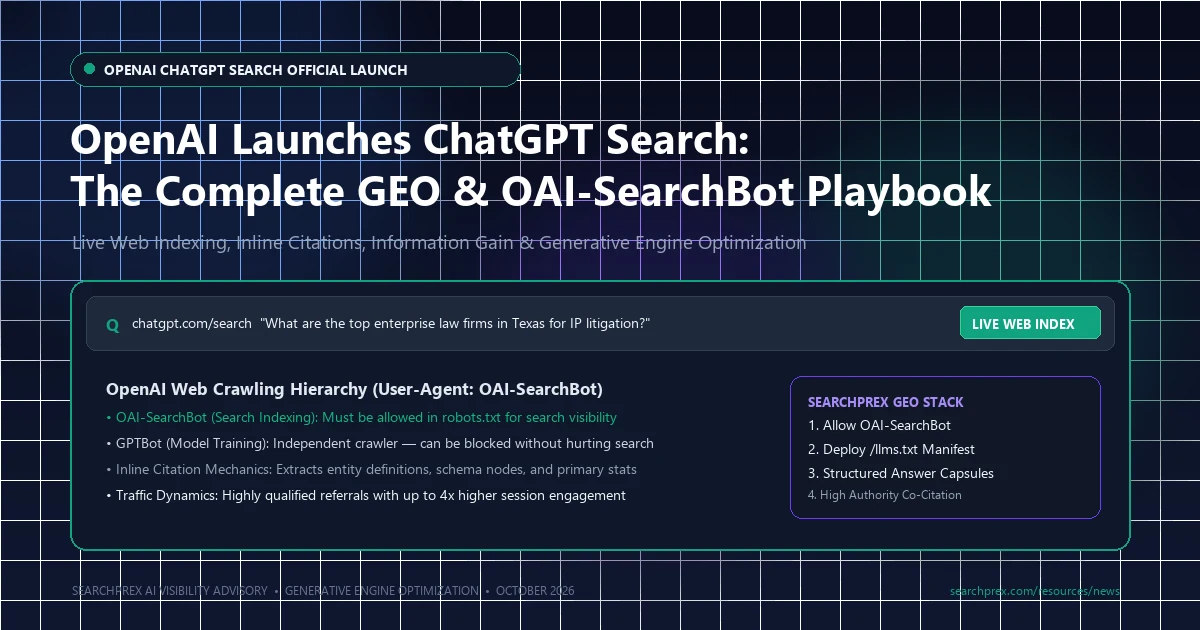
- Audit robots.txt for the training-versus-retrieval distinction. This is the cheapest high-impact fix available right now.
- Fix the dashboards that went dark when FAQ data left the Search Console API in August.
← Back to the SEO News hub for the running algorithm tracker and every other deep-dive.
Sources
- Google Search's I/O 2026 updates: AI agents and more — Google Blog
- Introducing Search Generative AI performance reports in Search Console — Google Search Central
- Google February 2026 Discover core update is now complete — Search Engine Land
- Google to no longer support FAQ rich results — Search Engine Land
- Google launches Universal Commerce Protocol for agent-led shopping — Search Engine Land
- Google Search's core updates and your website — Google Search Central
Mubashar Shahzad
Dedicated to tracking and decoding the latest Google algorithm updates and SEO trends.