Google spent 2026 building a checkout that happens inside the AI answer. For ecommerce SEO, the product feed is quietly becoming more important than the product page.
Table of Contents(7 sections)
Ecommerce SEO update log
Reverse chronological. Every entry carries a date, a source, and a label saying how well established it is.
September 17, 2026 — Bing tests deal and popularity labels on product carousels
Observed. Bing product carousels showing labels including "Top Picks", "Sale" and "Price Drop", plus view counts; the Top Picks label was spotted by Khushal Bherwani. Microsoft has not commented, and Search Engine Roundtable notes some of the labels may not be new.
September 16, 2026 — Google's holiday agentic commerce update
Confirmed — Google Blog. AI performance insights in Merchant Center is now available to businesses in Australia, Canada, India, New Zealand and the US. Merchants using the Merchant Center UCP integration hub can enable "cart transfer to a merchant site," with the new capabilities "gradually rolling out in the U.S., with Australia and Canada to follow early next year." Google also opened a Business Agent beta for YouTube ads and pointed retailers at feed attributes: during testing with lululemon, "conversational attributes submitted from the brand were incorporated 50% of the time in relevant product recommendations in AI Mode." That is one brand's test, not a general rate — but it is Google saying brand-supplied feed attributes shape AI Mode recommendations.
July 24, 2026 — New review snippet guideline on incentivized reviews
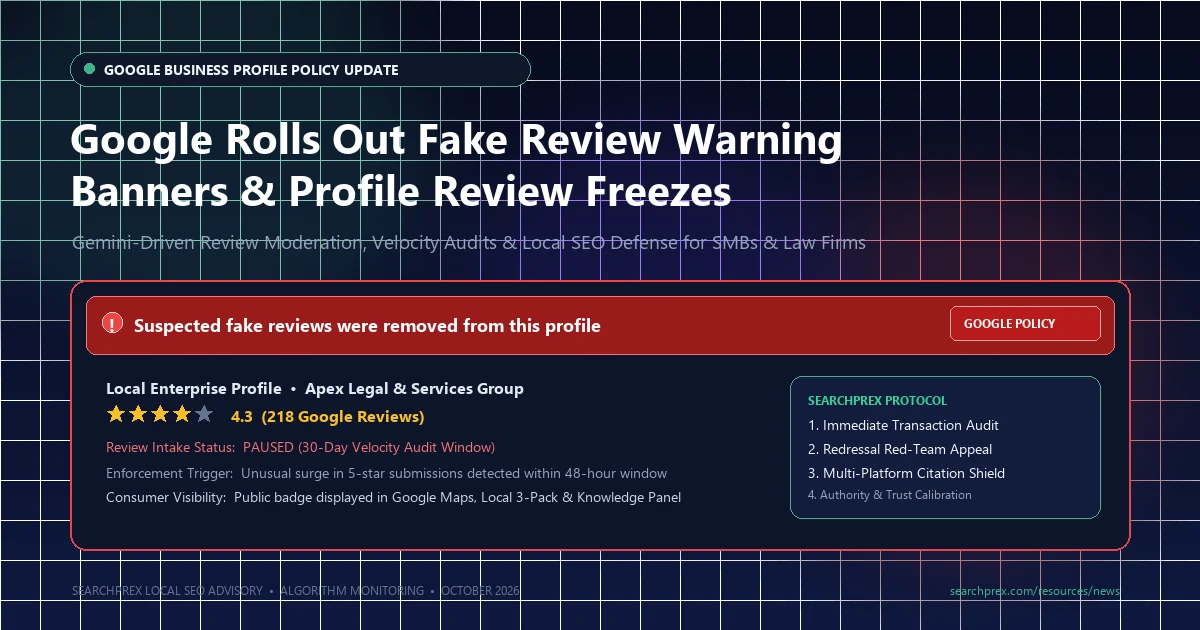
Confirmed — Search Central documentation changelog. Google added a guideline to the review snippet documentation "about fake and undisclosed incentivized reviews," to "improve user review transparency." If your product pages mark up reviews, audit how those reviews were collected.
July 14, 2026 — Package tracking program closes to new partners
Confirmed — Search Central documentation changelog. "The package tracking early adopters program is no longer accepting new partners."
July 7, 2026 — Product categories and sale dates in merchant listing markup
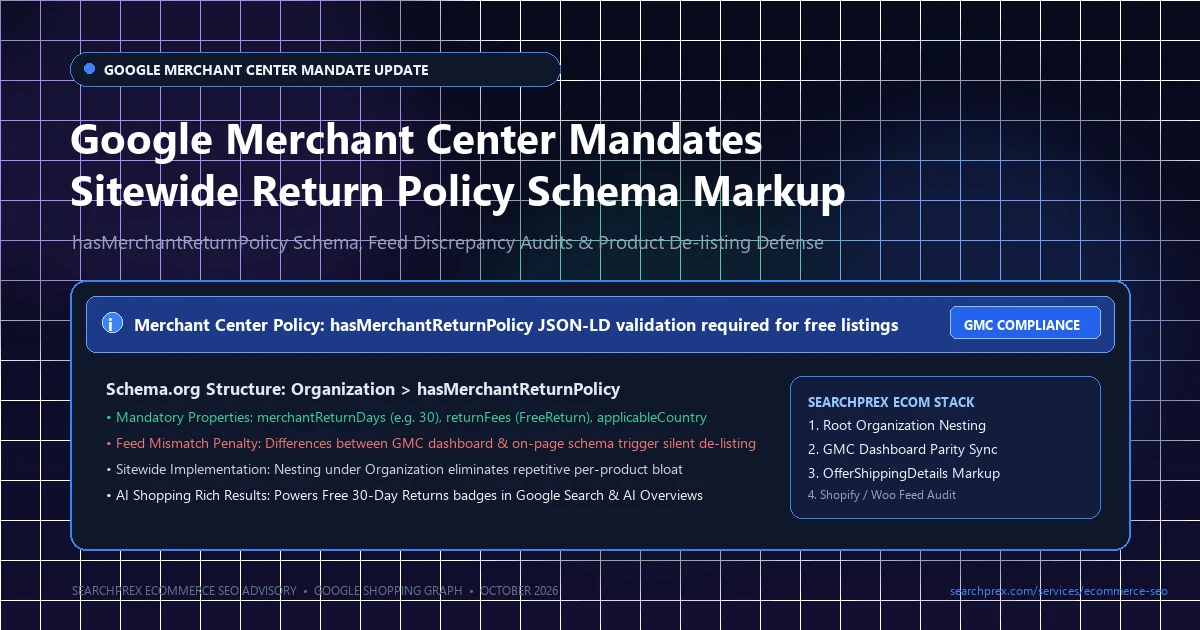
Confirmed — Search Central documentation changelog. Product.category can now be used "with both Text and CategoryCode types," aligning with Merchant Center's product_type and google_product_category attributes. A new "Sale duration" section explains using validFrom, validThrough and priceValidUntil to set sale price dates, aligned with the sale_price_effective_date feed attribute. Both are exactly the feed-and-markup reconciliation recommended below.
May 20, 2026 — hasAdultConsideration added to product structured data
Confirmed — Search Central documentation changelog. The property was added to the Merchant listing and Product variant documentation; it "brings parity with the Merchant Center feed specification for the adult property."
March 19, 2026 — UCP adds cart, catalog access and identity linking
Confirmed — Google Blog. Shopping agents can save multiple items from one store to a cart at once and "retrieve select real-time product details from a retailer's catalog," and identity linking lets shoppers keep loyalty benefits on integrated platforms. Google said a simplified UCP onboarding process in Merchant Center would roll out "over the coming months," and named Commerce Inc, Salesforce and Stripe as partners implementing UCP.
January 11, 2026 — Google launches the Universal Commerce Protocol
Confirmed. The open standard behind agentic checkout on Google — covered in detail below.
January 11: Google launches the Universal Commerce Protocol
Google introduced the Universal Commerce Protocol (UCP) on January 11, 2026 — an open standard establishing a shared language between AI agents and commerce systems, removing the need for custom integrations for every agent or platform. It spans the whole journey: discovery, purchase, and post-purchase support, and it works alongside existing standards including Agent2Agent and the Model Context Protocol.
It was built with Shopify, Etsy, Wayfair and Target, and endorsed by 20+ further retail and payments companies. The point of UCP is to put a working buy button on Google surfaces — specifically inside AI Mode in Search and the Gemini app.
Announced alongside it: Business Agent, branded AI assistants for retailers, live at launch with Lowe's, Michael's, Poshmark and Reebok; and Direct Offers, a Google Ads pilot showing exclusive discounts to shoppers close to a purchase decision.
Through 2026: onboarding, Universal Cart, and where checkout is live
Google has been widening access since:
- Merchant Center onboarding — a simplified UCP onboarding path aimed at bringing in retailers of all sizes, not just enterprise partners, rolling out through the year.
- Universal Cart — announced at I/O 2026 in May, extending agentic shopping beyond single-merchant checkout.
- Live checkout — UCP-powered checkout began rolling out for US shoppers buying from Etsy and Wayfair directly inside AI Mode in Search and the Gemini app, with Shopify, Target and Walmart named as following.
- Geographic expansion — Canada and Australia named as next, with the UK after, plus expansion into new categories including hotel booking and local food delivery.
- Ask Advisor — an agentic assistant inside Merchant Center intended to surface insights against business goals and connect across Google Ads and Analytics.
CUSTOM SEO DIAGNOSTIC · ECOMMERCE
How Does "Ecommerce SEO News 2026: UCP, Universal Cart and Agentic Checkout" Apply to Your Website?
Send me your URL and I'll check your site personally against what you just read — technical bottlenecks, competitor gaps, and whether Google's AI names you or them. Free reply within 24 hours.
What this actually changes for ecommerce SEO
The shift is easy to state and uncomfortable to act on: when a purchase completes inside an AI surface, your product page never renders. Everything that page was doing — merchandising, reassurance, cross-sell, reviews above the fold, the design work you paid for — is bypassed. What the agent consults instead is your structured data and your feed.
Concretely, that moves effort toward:
- Feed completeness and accuracy. Missing attributes, stale pricing and wrong availability have always cost you Shopping impressions. In an agentic flow they can disqualify you from a transaction entirely, because an agent will not offer to buy something it cannot confirm is in stock at the stated price.
- Product structured data that matches the page and the feed. Disagreement between feed, page markup and rendered page is the most common and most fixable failure we see. Validate with the Rich Results Test.
- Real-time inventory and price accuracy. Freshness is becoming a qualification criterion rather than a quality bonus.
- Post-purchase data. UCP explicitly covers post-purchase support, so returns policies, shipping terms and order status are part of the surface area now.
What has not changed
It is worth resisting the urge to rebuild everything. Google's stated position is that optimising for its generative AI features is still SEO, resting on the same fundamentals: content that serves the customer, a clean technical structure, and accurate product detail. There are no special AI-only files or additional technical requirements for appearing in those features.
Traditional ecommerce SEO also still carries the majority of revenue for most stores today:
- Category pages remain the highest-value ranking assets for head and mid-tail commercial queries.
- Crawl efficiency across large SKU counts, faceted navigation control and canonical hygiene are unchanged in importance.
- Core Web Vitals still govern the experience for every visitor who does arrive on the page.
- FAQ markup on product pages no longer earns a rich result — it stopped appearing on May 7, 2026. Keeping it is harmless; counting on it is not. See our technical SEO news roundup.
A sensible order of work
- Audit the feed before the page. Completeness, price accuracy, availability freshness, attribute coverage.
- Reconcile the three sources of truth — feed, structured data, rendered page — and fix disagreements.
- Review Merchant Center for UCP onboarding eligibility if you sell in a market where agentic checkout is live or named as next.
- Keep investing in category-page SEO. It is still where most ecommerce organic revenue originates.
- Start recording AI impressions from Search Console's generative AI reports — no backfill exists, so your baseline starts the day you begin exporting. See our SEO tools news roundup.
← Back to the SEO News hub for the running algorithm tracker and every other deep-dive.
Sources
- Bing Testing Top Picks Label, Sale, Price Drop & More On Product Carousels — Search Engine Roundtable, September 17, 2026
- Boost your holiday sales with these agentic commerce updates — Google Blog, September 16, 2026
- Latest Google Search Documentation Updates — Google Search Central
- AI shopping gets simpler with Universal Commerce Protocol updates — Google Blog, March 19, 2026
- Google launches Universal Commerce Protocol for agent-led shopping — Search Engine Land
- Google expands Universal Commerce Protocol and launches new agentic shopping tools — Search Engine Land
- Google Shopping introduces Universal Cart, agentic shopping — Google Blog
- New tech and tools for retailers to succeed in an agentic shopping era — Google Blog
- Google to no longer support FAQ rich results — Search Engine Land

Mubashar leads SearchPrex’s founder-led SEO work for law firms, local businesses and ecommerce brands. He combines technical audits, Search Console data and local market research to build practical search strategies, with more than five years of hands-on experience across 20+ clients.
Join the Discussion or Request Our Next Topic
Share your perspective in the public thread below, or tell us what SEO teardown, case study, or update regarding Ecommerce SEO News 2026: UCP, Universal Cart and Agentic Checkout you want us to cover next.
Community Perspectives (0)
Loading discussion...