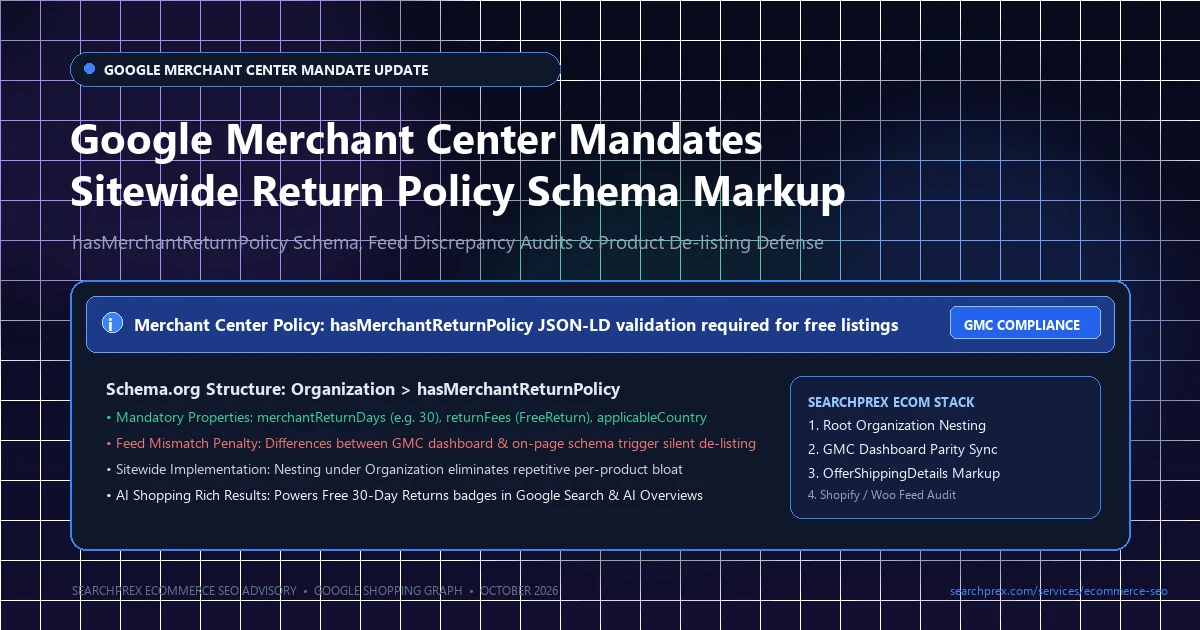
Google asks merchants to make return policies accurate and easy to find. Return-policy structured data can help Google understand that information, but it is not a universal sitewide schema mandate.
Table of Contents(5 sections)
Key takeaways
Merchants should provide accurate return information in Merchant Center and make the policy easy for shoppers to find on the site. That is separate from adding Schema.org return-policy markup. Google's documentation describes supported structured-data options; it does not establish a universal requirement to add sitewide return-policy schema to keep products approved.
- Keep return details in Merchant Center and on the website accurate and consistent.
- Use structured data only when it accurately represents the visible policy and follows Google's current guidance.
- Do not promise that markup is required for approval or guarantees a rich result.
Merchant Center policy information versus schema
Google's Merchant Center guidance says merchants should add return-policy information to their products and make the policy easy to find on their website. Product-level return data can be used to provide or override details, while account-level settings can cover the broader catalog.
Separately, Google Search Central documents MerchantReturnPolicy structured data as a way to describe return information. Google also supports return settings in Merchant Center or Search Console for eligible setups. These options serve related but distinct purposes; adding schema is not the same as configuring a Merchant Center policy.
A practical ecommerce checklist
- State the return window, eligible items, return method, fees, and refund timing in a clear customer-facing policy.
- Configure the relevant account-level policy in Merchant Center and use product-level overrides only when an offer differs.
- If you add structured data, ensure it matches the visible policy and correct organization or offer.
- Use Google's Merchant Center and Search Console diagnostics to review shipping and return settings.
- Do not mark up a policy shoppers cannot find on the site.
CUSTOM SEO DIAGNOSTIC · ECOMMERCE
How Does "Google Merchant Center Return Policy: What Is Required and What I..." Apply to Your Website?
Send me your URL and I'll check your site personally against what you just read — technical bottlenecks, competitor gaps, and whether Google's AI names you or them. Free reply within 24 hours.
Quick answers
Is sitewide return-policy schema mandatory for Merchant Center?
Google's documentation does not state a universal requirement to add sitewide Schema.org return-policy markup for product approval. Merchants should still configure accurate policy information and make it easy to find.
Can return settings be managed without schema?
Google provides Merchant Center settings and, for supported properties, Search Console controls for shipping and returns. Follow the documentation available for your account and country.
Does adding schema guarantee a rich result or better rankings?
No. Structured data helps Google understand eligible information but does not guarantee a rich result or ranking improvement.
Sources
- Google Merchant Center: Keep your account approved
- Google Search Central: Merchant return policy structured data
- Google Search Console: Shipping and return settings
Last checked: October 23, 2026.

Mubashar Sharif
Founder & SEO Strategist at SearchPrex, specializing in Google search volatility, technical architecture, and Generative Engine Optimization (GEO).
Join the Discussion or Request Our Next Topic
Share your perspective in the public thread below, or tell us what SEO teardown, case study, or update regarding Google Merchant Center Return Policy: What Is Required and What Is Optional? you want us to cover next.
Community Perspectives (0)
Loading discussion...